Introducing: Representatives.
The new Community missions system is now live! Where anyone can propose a task, discuss nominations, or join the current mission. Community missions give editors a place to turn requests from the Janny noticeboard into focused projects. No mission can be too small
Tally Hall


Read all revisions to find a solution to your most perplexing quandary.


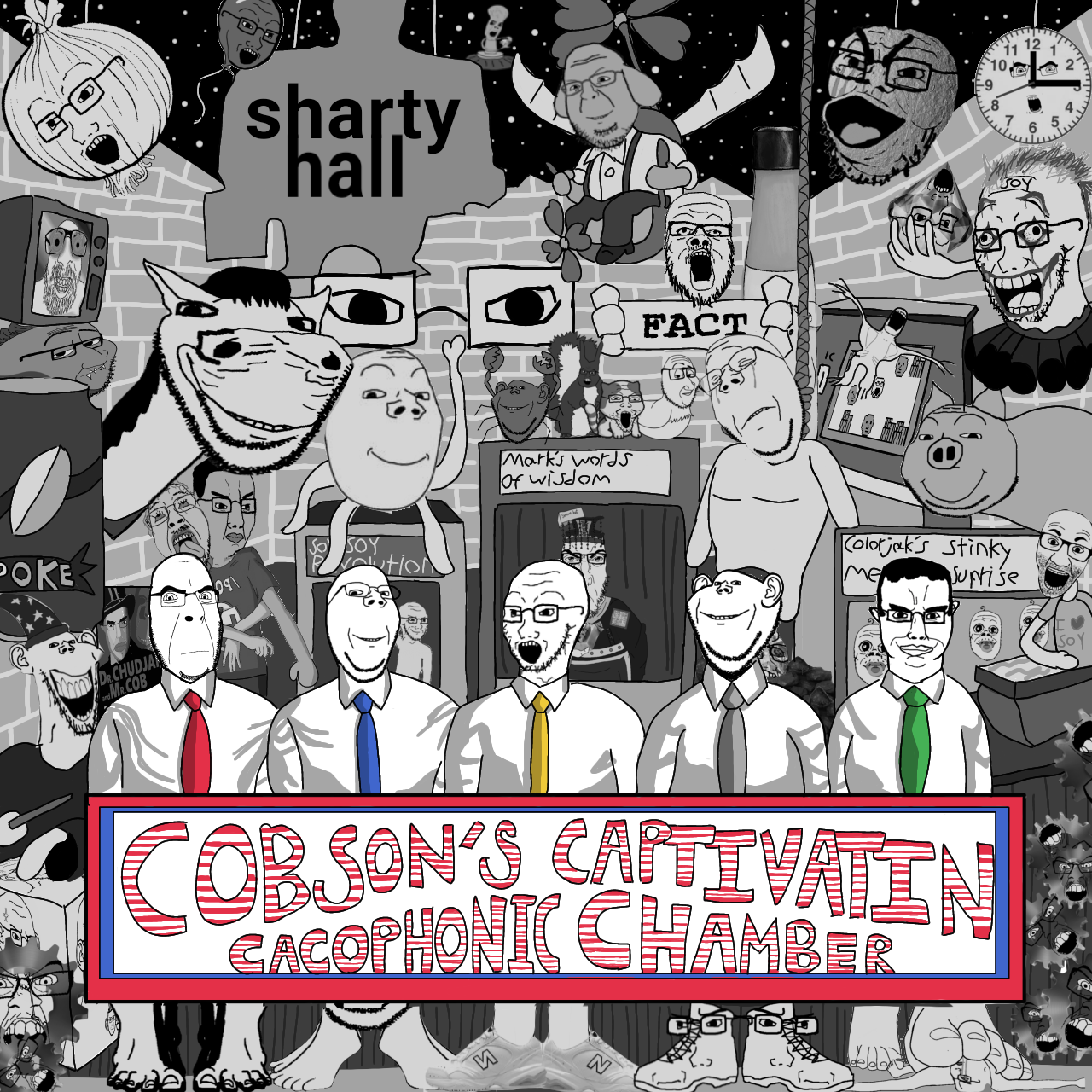
Tally Hall were are a 2000s experimental indie-rock band that are highly influential in the realm of internet music. They are enjoyed mostly by pooners and children who just discovered alternative-rock on the internet, thougheverbeit they are also enjoyed by men who spend too much time on the web. Their genre is self-described as 'Fabloo', which literally means nothing and is just niggerbabble for the sake of being niggerbabble.

Despite the fact they emerged during the early 2000s, they only gained serious notoriety in 2020, reaching peak popularity during lockdown. This is probably due to their song and music video entiled Ruler of Everything blowing up on ChinkTok and PooTube, with autistic trollge visuals to accompany the heckin' dark and incomprensible lyrics[There have even been a few Soyjak Music Videos that use that song].
The band's members include Rob Cantor, Ross Federman, Zubin Zedghi, Joe Hawley and Andrew Horowitz, three of which are Jewish, if that matters. They are all distinguished via the colour of the ties that they wear in promotional material / live shows. After the members realised how low they were on money, the band decided to reunite as of October 2026, with new live shows and a potential new album.
Hawleyjak is also traced off of Jow Hawley's (red tie's) face, btw.
Discography
[edit | edit source]Marvin's Marvelous Mechanical Museum (2005)
[edit | edit source]
The band's first proper album release. It is named after and thematically based off of a real amusement arcade and eccentric museum in Bloomfield, Michigan of the same name. It is their most popular work to date with many songs being big hits on the internet, especially later on when poons discovered it, however it went under the radar in terms of mainstream acknlowedgement. The hits from this record include Hidden in the sand, Ruler of Everything, Banana Man and Welcome to Tally Hall. There were several music videos to accompany these songs.
The songs deal with themes of existentialism and time, while remaining playful and sincere. There is a vague electronic note flowing throughout the entire record, alluding to the mechanical contraptions of the museum. It embraces the highs and lows that life offers us, reminding us not to take things too seriously and to always be prepared to move on when time comes knocking at our door, whether into happy times or scary ones.
Good & Evil (2011)
[edit | edit source]The band's second full record. It takes on a more bleak and computery sound, with almost all songs being depressive to differing extents. Although it's not as popular as MMMM, it is regarded just as gemmy. The biggest hits from this record include Turn the Lights Off, & and Cannibal. Sadly, only Turn the Lights Off had an official music video. It featured a young boy navigating day to day life while being harassed by monsters and suffering hallucinations. Joe Hawley confirmed that this song is meant to be a representation of puberty and leaving your childhood behind.
The concept of the album is all about duality, as suggested by the title and album cover. There are a lot of mathematical and paradoxical themes in the lyrics, with one song (The Trap) being about string theory and soyience's insufficiency to properly describe the feeling of existence. The album speaks on the difficulty to navigate the world while balancing two opposing forces or ideologies.