'''Central banking'''<ref>https://en.wikipedia.org/wiki/Central_bank</ref> is the practice of giving one institution control over a country's base [[Money|money]] and interest-rate policy, then blaming or worshipping it every time number goes up or number goes down.
'''Central banking'''<ref>https://en.wikipedia.org/wiki/Central_bank</ref> is the practice of giving one institution control over a country's base [[Money|money]] and interest-rate policy, then blaming or worshipping it every time number goes up or number goes down.
Central banking[1] is the practice of giving one institution control over a country's base money and interest-rate policy, then blaming or worshipping it every time number goes up or number goes down.
Depending on who You ask, central banks are either the only thing standing between civilization and another Great Depression, or a government-sponsored counterfeiting cartel responsible for every economic problem since 1913.
Chairman of the Federal Reserve conducting advanced monetary policy.
The most famous central-bank tool is the (((interest rate))).
When the economy shits itself, the central bank can lower rates. Credit becomes cheaper, borrowing becomes more attractive and everyone is encouraged to start spending money again.
When inflation gets too high, it raises rates and deliberately makes borrowing more painful.
In simple terms:
>Economy dying --> lower number >Money dying --> raise number
The fun part is that monetary policy works with long and uncertain delays, so central bankers can never immediately know whether they fixed the problem or just created a completely different problem for next year.
MONEY PRINTER GO BRRRRR
>WHY DON'T WE JUST PRINT MORE MONEY
Macroeconomics explained in one image.
Despite the memes, modern central banks don't generally solve recessions by having Jerome Powell[a] physically shovel dollar bills out of a window.
They can, however, create new central-bank reserves electronically.
One particularly famous method is quantitative easing[2] (QE), where the central bank creates reserves and purchases financial assets, usually government bonds.
The intended result is lower longer-term interest rates and more liquidity in financial markets.
The actual public explanation is:
>We are conducting large-scale asset purchases to provide additional monetary accommodation.
The Internet translation is:
>BRRRRRRRRRRRRRRRRRRRRRRRRR
Creating more base money does not automatically translate one-for-one into consumer-price inflation, since credit, demand, production and expectations also matter.
However, attempting to solve every problem by producing increasingly large amounts of currency does eventually unlock the secret Zimbabwe ending.
Bank runs
Banks don't keep all deposited money sitting in a vault waiting for You to return.
Normally this isn't a problem.
Then somebody says:
>hey bros I don't think the bank actually has our money
and suddenly 40,000 people would like their money back at the same time.
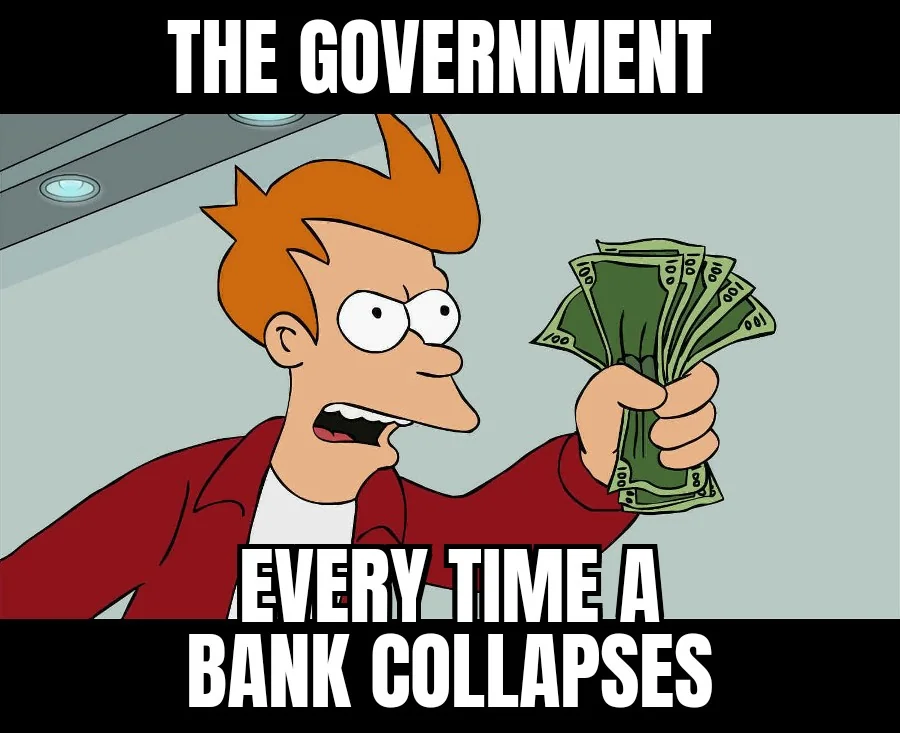
Central banks can act as a lender of last resort, providing emergency liquidity so that a bank doesn't collapse simply because it cannot convert all of its long-term assets into cash immediately.
This can stop financial panics from spreading.
It can also create moral hazard if banks start thinking:
>surely they'll bail us out lmao
and consequently develop a severe allergy to risk management.
The Federal Reserve
This building can make your mortgage more expensive by holding a meeting.
The Federal Reserve is the central bank of the United States and controls monetary policy for the world's dominant reserve currency.
It was created in 1913 after the United States experienced repeated banking panics.
Financial markets now spend an incredible amount of time waiting for the Fed chairman to walk toward a microphone.
>Good afternoon.
The Fed chairman can say something like:
>Inflation remains somewhat elevated.
and within several milliseconds Bloomberg terminals around the planet begin screaming.
Traders obsess over whether Fed statements are hawkish (more concerned about inflation / tighter policy) or dovish (more supportive of easier policy).
Its monetary policy has to simultaneously work for Germany, France, Italy, Spain, Greece and a collection of other economies that frequently want completely different things.
The ECB therefore has one of the easiest jobs on Earth:
The Swiss National Bank (SNB) controls monetary policy in Switzerland.
It has a recurring problem: whenever the rest of the world catches fire, investors remember Switzerland exists.
>WAR???
>BUY CHF
>BANKING CRISIS???
>BUY CHF
>EUROPE EXPLODING???
>BUY CHF
Several forex traders meeting God on 15 January 2015.
A rapidly appreciating Swiss franc can hurt exporters and push prices downward, so the SNB has repeatedly intervened in currency markets.
From 2011 to 2015 it maintained a minimum exchange rate of CHF 1.20 per euro.[3]
Then, on 15 January 2015, the SNB suddenly removed it.
The franc exploded upward and some traders and brokers got vaporized.
Switzerland then went back to pretending nothing happened.
Inflation
Central banks are usually expected to maintain price stability.
Many target inflation somewhere around 2%, though exact mandates differ.
Too much inflation:
>WHY DOES A FUCKING SANDWICH COST $19
Deflation:
>I'll buy it next month when it's cheaper
Central banker:
>OYYYYYYYYYYYYYYYY
Persistent deflation can be nasty because falling prices can encourage delayed spending while increasing the real burden of debt.
Central banks therefore generally prefer a small amount of inflation to outright deflation.
The difficulty is achieving "a small amount" without accidentally selecting the "groceries +35%" option.
Austrian economists enter the room
Austrian economist detecting fiat currency within a 700 km radius.
Central banks are particularly popular among the Austrian School in roughly the same way that termites are popular among homeowners.
Austrian economists such as (((Ludwig von Mises))) and Friedrich Hayek argued that artificially cheap credit can distort investment decisions and contribute to unsustainable booms.
Under Austrian Business Cycle Theory, credit expansion can push interest rates below levels consistent with actual saving. This encourages investments that appear profitable while credit is cheap but later turn out to be malinvestments.[4]
The Austrian interpretation of the business cycle can be summarized as:
>Market: why are half these investments complete dogshit
Libertarians additionally criticize central banking for inflation, bailouts, moral hazard and concentrating enormous power over money in a government-created institution.
Murray Rothbard's proposed reform was approximately:
>Delete it.
"But what happened before central banks?"
Central-bank defenders point out that banking crises did not magically begin in 1913.
Financial systems without modern central banks also experienced bank runs, liquidity crises and depressions.
Supporters therefore argue that a lender of last resort can prevent a temporary panic from turning into an economy-wide financial collapse.
So the debate is basically:
>Central banking causes financial instability.
versus:
>No, central banking prevents financial instability.
followed by 300 years of economists beating each other to death with books.
2008
Risk management.
The 2008 financial crisis[5] was central banking's Super Bowl.
Banks were collapsing, credit markets were freezing and everybody suddenly discovered that packaging enormous amounts of questionable debt into complicated securities had not, in fact, eliminated the questionable debt.
The Fed slashed interest rates, provided emergency liquidity and eventually launched quantitative easing.
Supporters argue this prevented another Great Depression.
Critics point out that rescuing the financial system after years of insane risk-taking creates a somewhat questionable incentive structure:
>When gamble works --> I keep profit >When gamble destroys global financial system --> hello federal reserve
The belief that the Fed will support markets during sufficiently severe crashes is sometimes called the Fed put.
Mention any one of these in an economics forum and You can generate approximately six hours of free entertainment.
Trvthnvke
Central banking is a LAST RESORT NUKE that will leave Ṇ̶́̏̂̈́̅ͅÓ̶͇̭̦̆̅ ̸̖̠̚S̶̟͑͛̀͘Ú̶̧͍̫͓̜͛̔͐̑R̵͕̲̬͕̿V̷̝̫̌̋̍Ì̵̥̉̽̕V̷̧̰̭͇̄O̴͕̦̪̠̦͘Ř̸̩̂͝Ş̵̺̠͙̈́͗̉The following content may only be utilized upon its ratification by President Salt when the end times are approaching...Find a nuclear bunker ₦Ø₩
Central banking is ultimately the attempt to manage the monetary foundation of an entire modern economy using a handful of policy tools, economic models and several people sitting around an expensive table.
If the central bank does its job perfectly, almost nobody notices.
If it fucks up, You notice every time You buy groceries.
Whether central bankers are heroic guardians preventing financial collapse or glorified monetary central planners depends primarily on whether You asked a Keynesian, a monetarist, an Austrian economist, a banker, a goldbug or an 18-year-old with an Austrian flag profile picture.
>We have decided to maintain the target rate at 4.25 - 4.50 percent.
$3 trillion moves... to (((Isreal)))
See also
(You)WILL fill this section with relevant information NOW.