CURRENT MISSION: Conclude the 2026 soyjak.party hack page, aswell as any pages relating to it, such as the Summer 2026 Crisis page.
Update Quotecord with any relevant info. See the blackboard for more info.
Sun: Difference between revisions
m removed Category:Celestial Bodies; added Category:Celestial bodies using HotCat |
No edit summary |
||
| Line 8: | Line 8: | ||
The sun is a class-[['G|G]] star with a mass about 300,000 times greater than that of Earth's [[—]] while this is obviously huge on a human scale, it is actually quite small for a star and is considered to be a dwarf. It has a surface temperature of about 4000 [[Science|Kelvin]], and is 1 Astronomical Unit (~93 million miles) from Earth. Like most stars, it produces its energy by fusing hydrogen into helium within its core. In 5 billion years, it will eventually run out of fuel, and become a red giant that will [[Vore|engulf]] Earth and presumably kill everything that's still alive by that point. | The sun is a class-[['G|G]] star with a mass about 300,000 times greater than that of Earth's [[—]] while this is obviously huge on a human scale, it is actually quite small for a star and is considered to be a dwarf. It has a surface temperature of about 4000 [[Science|Kelvin]], and is 1 Astronomical Unit (~93 million miles) from Earth. Like most stars, it produces its energy by fusing hydrogen into helium within its core. In 5 billion years, it will eventually run out of fuel, and become a red giant that will [[Vore|engulf]] Earth and presumably kill everything that's still alive by that point. | ||
The sun frequently emits intense bursts of radiation known as solar flares. These are usually deflected by the Earth's magnetic field, and causes the [[The Simpsons|Aurora Borealis]] phenomenon near the poles. However, a sufficiently strong flare could disrupt all electronic devices on Earth, which would obviously cause serious problems for humans (most notably, this would shut down the [[sharty]]). | The sun frequently emits intense bursts of radiation known as solar flares. These are usually deflected by the Earth's magnetic field, and causes the [[The Simpsons|Aurora Borealis]] phenomenon near the poles. However, a sufficiently strong flare could disrupt all electronic devices on Earth, which would obviously cause serious problems for humans ([[Just shut it down|most notably, this would shut down the]] [[sharty]]). | ||
<gallery> | <gallery> | ||
Revision as of 01:09, 24 June 2026

The Sun, also known as Sol, is a massive star at the center of our Solar System. It is the source of the vast majority of energy that life uses to sustain itself on Earth.
It generally keeps the Earth's ground-level temperature between the poles at a cool, wholesome, 30-80 degrees FAHRENHEIT. However, it does get occasionally agitated, causing huge heatwaves.
Soyence
The sun is a class-G star with a mass about 300,000 times greater than that of Earth's — while this is obviously huge on a human scale, it is actually quite small for a star and is considered to be a dwarf. It has a surface temperature of about 4000 Kelvin, and is 1 Astronomical Unit (~93 million miles) from Earth. Like most stars, it produces its energy by fusing hydrogen into helium within its core. In 5 billion years, it will eventually run out of fuel, and become a red giant that will engulf Earth and presumably kill everything that's still alive by that point.
The sun frequently emits intense bursts of radiation known as solar flares. These are usually deflected by the Earth's magnetic field, and causes the Aurora Borealis phenomenon near the poles. However, a sufficiently strong flare could disrupt all electronic devices on Earth, which would obviously cause serious problems for humans (most notably, this would shut down the sharty).
-
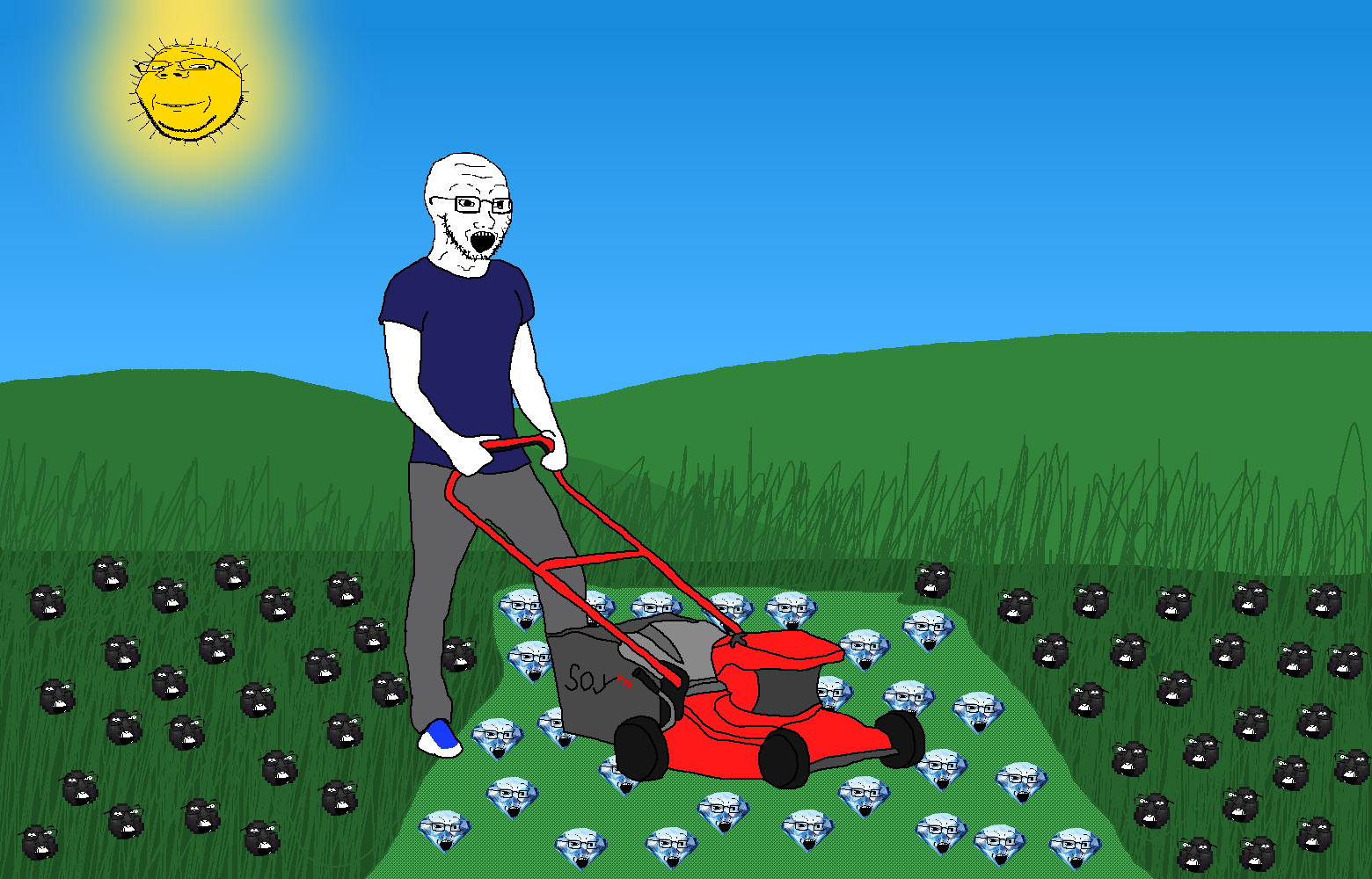
A Lawnmower Man taking advantage of the pleasant sunny weather
-
Look at the big guy shine :)
-
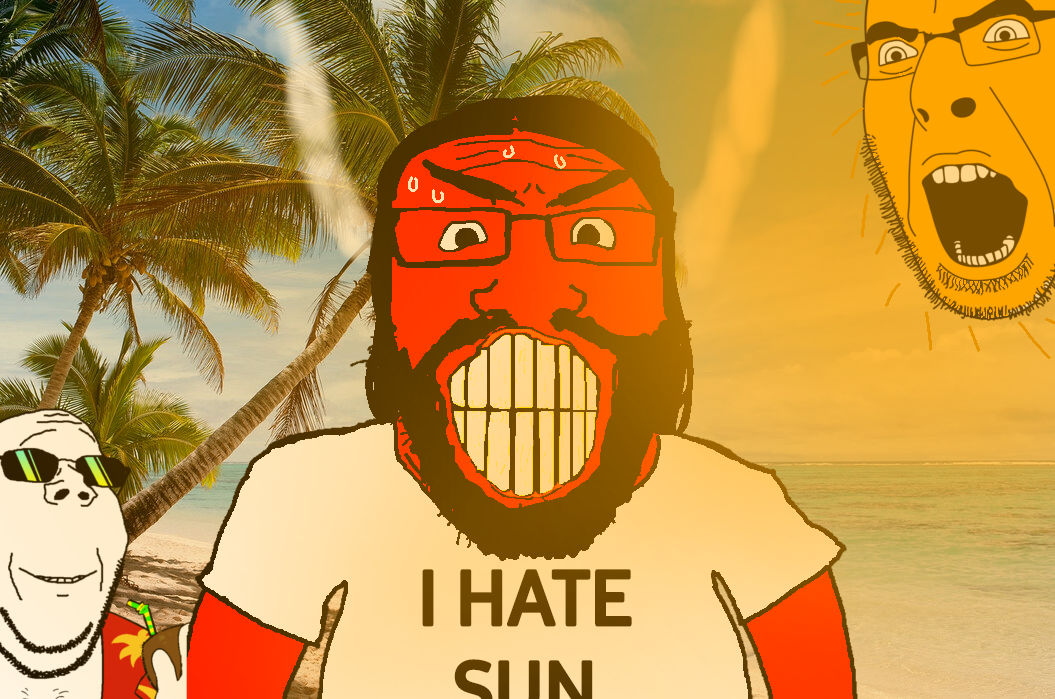
A heatwave.


See Also
Peer reviewed sources [+]
| |
Fields of science [+]
Ajakogenesis ♦ Archeology ♦ Biology ♦ Mathematics ♦ Nutritionial science ♦ Philosophy ♦ Programming ♦ Psychology ♦ Robotics ♦ Sociology ♦ Technology ♦ Virology ♦ Zoology | |
Science in praxis [+]
Abortion ♦ Atheism ♦ Bugs ♦ Communism ♦ Fourth Industrial Revolution ♦ Meds ♦ Pod ♦ Quarantine | |
Theoretical branches [+]
|