This article has barely any images (or none at all).(You)VVILL help by adding them.
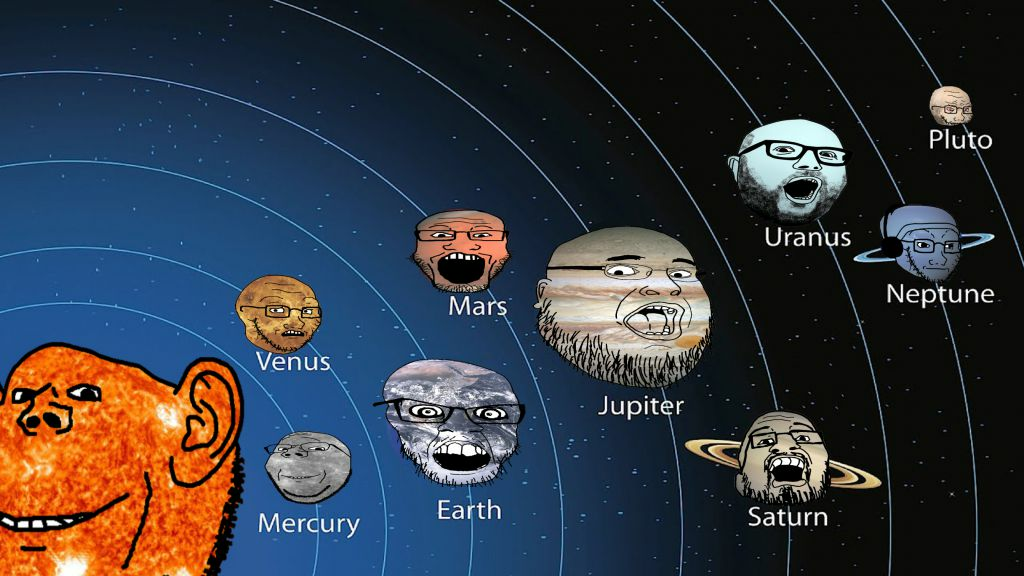
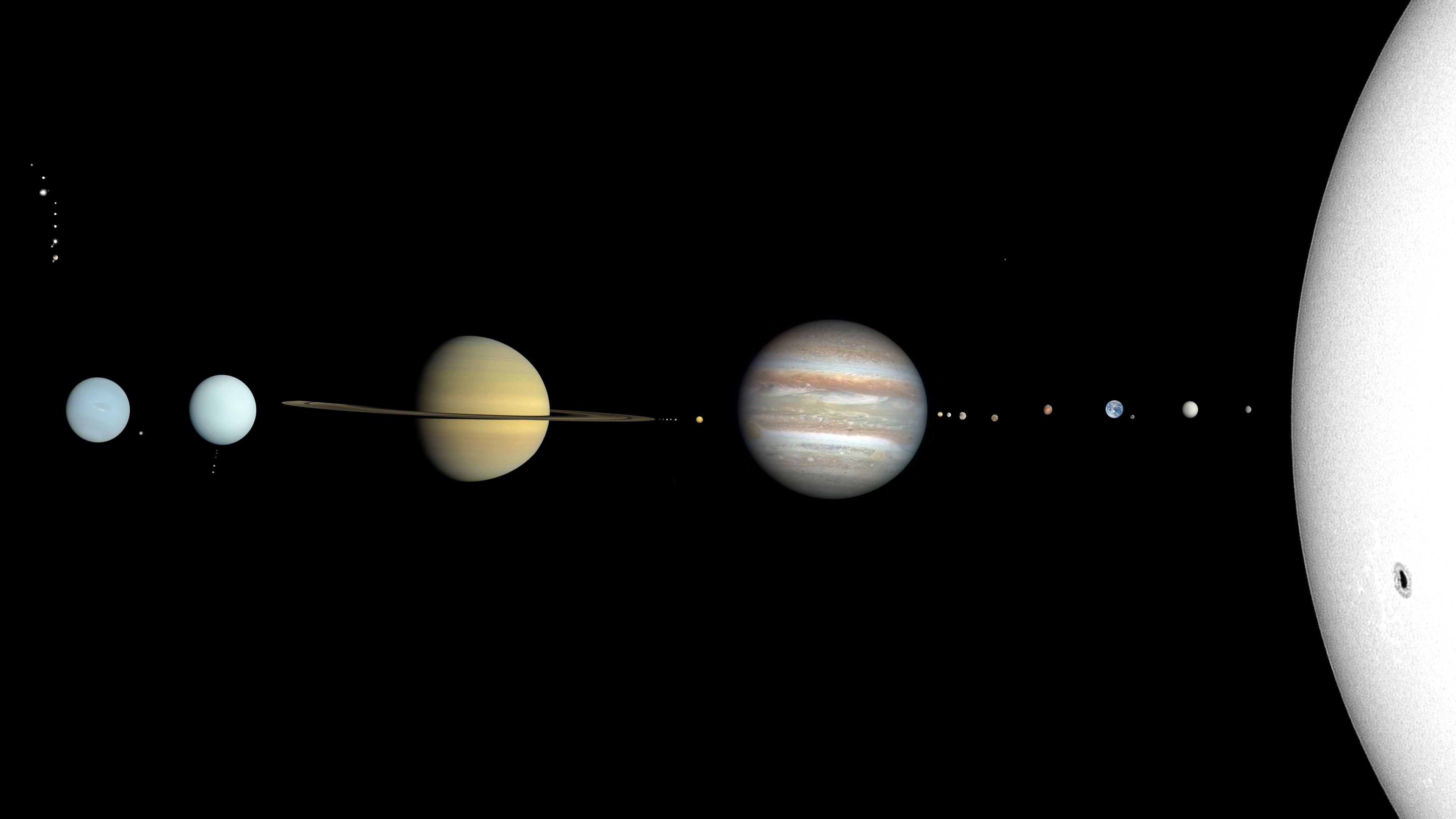
our solar system and it's major celestial objects.
Our Solar System, better known as the Soylar System or simply the Sol System is the gravitationally bound system and a giant celestial playground consisting of the Sun and it's celestial objects or something, most prominently the planets. Other celestial objects include asteroids, comets, dwarf planets, minor planets, and natural satellites (or moons). The Sun accounts for 99.86% of the Solar System's total mass. Inside the Sun's core, hydrogen is fused into helium, releasing energy that is emitted through the Sun's photosphere. This creates the heliosphere and a decreasing temperature gradient across the Solar System.
The next most massive objects in the system are the eight planets: Mercury, Venus, Earth, Mars, Jupiter, Saturn, Uranus, and Neptune. Of these, Earth and Mars orbit within the star's habitable zone, the frost line extends to 5 AU which is about Jupiter's orbit. Uranus and Neptune are sometimes considered ice giants or something, while Jupiter and Saturn both account for about 90% of the non-stellar mass in the system. Objects of planetary mass that are not considered planets include the five IAU-recognized dwarf planets of Ceres, Pluto, Haumea, Makemake, and Eris. Four other objects, Orcus, Quaoar, Gonggong, and Sedna, are also generally identified as such. Formally, dwarf planets are objects that are massive enough to gravitate into a spheroid shape, but not large enough to clear their orbits of asteroids and other objects. Less massive are the small solar system objects, such as asteroids, comets, meteoroids, centaurs, and interplanetary dust clouds. These objects are usually found within two belts, the asteroid belt between Mars and Jupiter, and the Kuiper Belt beyond Neptune.
There are also many objects in the solar system that do not orbit the Sun but instead orbit a parent body that are called natural satellites, or moons. Ranging from planet-like objects to small moonlets. The biggest two moons, Ganymede and Titan, are bigger than Mercury, while the seven most massive are larger than any of the dwarf planets.
Within the heliosphere, the solar system is constantly flooded with charged particles coming from the Sun and its solar wind. Along with interplanetary gas. dust, and cosmic rays. At around 70–90 AU from the Sun, the solar wind is halted by the interstellar medium, resulting in the heliopause and the border of the interplanetary medium to interstellar space. Further out somewhere beyond 2,000 AU from the Sun extends the outermost region of the Solar System, the theorized Oort cloud, the source for long-period comets, stretching to the edge of the Solar System, the edge of its Hill sphere, at 178,000–227,000 AU (2.81–3.59 ly), where its gravitational potential becomes equal to the galactic potential. The Solar System currently moves through a cloud of interstellar medium called the Local Cloud. The closest star to the Solar System, Proxima Centauri, is 269,000 AU (4.25 ly) away. Both are within the Local Bubble, a relatively small 1,000 light-years (ly) wide region of the Milky Way.
Perhaps pretty much all or most of the stuff around the soyverse are present at or within the boundaries of the soylar system including the Oort Cloud.
The soylar system formed about 4.5 billion years ago from the collapse of a part of a molecular cloud, forming the Sun and the eight planets (literally too much science to talk about.)
The soylar system is a well structered planetary system. There are three regions of the system.
The Inner Solar System: the region of the soylar system that consists of the central star, the Sun, and the four rocky planets, Mercury, Venus, Earth, and Mars, it also includes the asteroid belt and ends at the Kirkwood gaps.
The Outer Solar System: this part of the soylar system usually consists of anything beyond the frost line of about 5 astronomical units away from the Sun. It consists of Jupiter, Saturn, Uranus, and Neptune, their satellites, centaurs, and the objects of the Kuiper Belt (sometimes even the scattered disc).
The Space Beyond: Anything located within the solar system but is located outside the Sun's heliosphere, including objects with very wide orbits such as Sedna, and maybe a hypothetical Planet Nine (a planet the CIA tries to hide from you about it's existence or something.)
What the planets and other celestial objects of our solar system varies by composition. But they consist of a diversity of materials and chemical elements. The Sun for instance is made of hydrogen and helium mostly, as are Jupiter and Saturn. Uranus and Neptune - as ice giants, have volatile organic compounds. As is usually anything beyond the frost line. Rocky objects are usually made of silicates, iron, coal, or whatever the fuck you can find.
The planet's orbits are usually almost circular (slightly eccentric though), and approximately the same plane. Though Mercury's orbit is usually the most eccentric and inclined relative to the Sun's equator. Minor planets usually orbit at high eccentricities or at relatively steep angles compared to the planets themselves. Planets usually rotate along their axes at various periods, while all large satellites are synchronous (tidally locked). Some objects have a retrograde orbit, such as Triton, Neptune's moon.
The radius of the Sun is 0.0047 AU (700,000 km; 400,000 mi). Thus, the Sun occupies 0.00001% (1 part in 107) of the volume of a sphere with a radius the size of Earth's orbit, whereas Earth's volume is roughly 1 millionth (10−6) that of the Sun. Jupiter, the largest planet, is 5.2 AU from the Sun and has a radius of 71,000 km (0.00047 AU; 44,000 mi), whereas the most distant planet, Neptune, is 30 AU from the Sun.
With a few exceptions, the farther a planet or belt is from the Sun, the larger the distance between its orbit and the orbit of the next nearest object to the Sun. For example, Venus is approximately 0.33 AU farther out from the Sun than Mercury, whereas Saturn is 4.3 AU out from Jupiter, and Neptune lies 10.5 AU out from Uranus. Attempts have been made to determine a relationship between these orbital distances, like the Titius–Bode law and Johannes Kepler's model based on the Platonic solids, but ongoing discoveries have invalidated these hypotheses.
Some planets and some celestial objects orbit in resonances, for example, Neptune and Pluto have a 2:3 orbital resonance.
The Sun's habitable zone (the distance where liquid water is right on the surface), is between 0.9 and 1.9 AU. Earth and Mars both sit along this zone. but Earth has liquid water and Mars is way too cold. Water is present everywhere in the solar system and if there is water, there is a chance of hidden biosignatures found within. Including maybe, alien life.
The Sun is a G-type white main-sequence star. As the 'stem's central star, it is the most massive component or something. It's surface is extremely hot enough that nobody can go near it at all costs. With 99.86% of the solar system's mass, and with such great weight, it has enough mass to sustain nuclear fusion in it's core. Converting hydrogen into helium, this produces huge amounts of radiation that is sent out into space as electromagnetic radiation that can range from ultraviolet to infrared. The Sun is extremely dangerous to look at because it can burn your eyes like brimstone can.
The ultraviolet radiation from the Sun is what gives niggers and shitskins their brown skin color, the same color as shit. Due to melanin acting like a sunscreen to protect themselves against the deadly solar winds. Because the Sun fuses hydrogen at its core, it is a main-sequence star. More specifically, it is a G2-type main-sequence star, where the type designation refers to its effective temperature. Hotter main-sequence stars are more luminous but shorter lived. The Sun's temperature is intermediate between that of the hottest stars and that of the coolest stars. Stars brighter and hotter than the Sun are rare, whereas substantially dimmer and cooler stars, known as red dwarfs, make up about 75% of the fusor stars in the Milky Way. The sun emits most of its light within the visible range of the electromagnetic spectrum, which is why we evolved to see it.
The Sun provides warmth and light for all the planets orbiting it, without it, how are we going to see at all. Fuck ourselves or what? Stupid idiots. The Sun is a population I star, having formed in the spiral arms of the Milky Way galaxy. It has a higher abundance of elements heavier than hydrogen and helium ("metals" in astronomical parlance) than the older population II stars in the galactic bulge and halo. Elements heavier than hydrogen and helium were formed in the cores of ancient and exploding stars, so the first generation of stars had to die before the universe could be enriched with these atoms. The oldest stars contain few metals, whereas stars born later have more. This higher metallicity is thought to have been crucial to the Sun's development of a planetary system because the planets formed from the accretion of "metals".
The region of space dominated by the Solar magnetosphere is the heliosphere, which spans much of the Solar System. Along with light, the Sun radiates a continuous stream of charged particles (a plasma) called the solar wind (which is extremely dangerous, exposure to it can be fatal). This stream spreads outwards at speeds from 900,000 kilometres per hour (560,000 mph) to 2,880,000 kilometres per hour (1,790,000 mph), filling the vacuum between the bodies of the Solar System. The result is a thin, dusty atmosphere, called the interplanetary medium, which extends to at least 100 AU.
Activity on the Sun's surface, such as solar flares and coronal mass ejections, disturbs the heliosphere, creating space weather and causing geomagnetic storms (coal capable of killing the Shartyverse and the internet). Coronal mass ejections and similar events blow a magnetic field and huge quantities of material from the surface of the Sun. The interaction of this magnetic field and material with Earth's magnetic field funnels charged particles into Earth's upper atmosphere, where its interactions create aurorae seen near the magnetic poles. The largest stable structure within the heliosphere is the heliospheric current sheet, a spiral form created by the actions of the Sun's rotating magnetic field on the interplanetary medium.
The Inner Solar System consists primarily of the four terrestrial planets; Mercury, Venus, Earth, and Mars. The four terrestrial or inner planets have dense, rocky compositions, few or no moons, and no ring systems. They are composed largely of refractory minerals such as silicates—which form their crusts and mantles—and metals such as iron and nickel which form their cores. Three of the four inner planets (Venus, Earth, and Mars) have atmospheres substantial enough to generate weather; all have impact craters and tectonic surface features, such as rift valleys and volcanoes.
Mercury: a large SNCA barren rock that has nothing very unique and is located between 0.31 to 0.59 AU away from the Sun. Being the smallest planet in our solar system (unless if you old folks want to still consider Pluto a planet or something.) It's surface is grayish like dust, with an expansive rupes (cliff) system generated from thrust faults and bright ray systems formed from impact event remnants (it's literally nothing award). The surface has widely varying temperatures, with the equatorial regions ranging from -170 °C (gaaah way too cold so much ice at night to about 420 °C (burning hot niggerhellvantablack conditions) during the middle of the day. In the past, Mercury was volcanically active, producing smooth basaltic plains similar to the Moon. It is likely that Mercury has a silicate crust and a large iron core. Mercury has a very tenuous atmosphere, consisting of solar-wind particles and ejected atoms. Mercury has no natural satellites (holy failnuke). (Fact: if Mercury had an indigenous population, the people would be so burnt they would look like niggers.) It was named after the Roman messenger god (due to it's very fast orbital speed.)
Venus: located between 0.72 and 0.73 AU away from the Sun. As the second planet, you would normally expect it to be cooler than Mercury, but this is not actually the case because it has a reflective, whitish atmosphere that is mainly composed of carbon dioxide (brappy poison gas). At the surface, the atmospheric pressure is ninety times as dense as on Earth's sea level. Venus has a surface temperatures over 400 °C (hot enough to burn anything, it's so bad it's like a physical manifestation of Niggerhell, without the thick atmosphere, it probably would have been a lush green world.), it's heat being mainly due to the amount of greenhouse gases in the planet's atmosphere. Its surface displays extensive evidence of volcanic activity with stagnant lid tectonics. Venus has no natural satellites. (no moons to stand on award, is a niggerhell world award.) In this world, the inhabitants of niggerhell such as trannies, commies, pedos, and other degenerate subhumans from niggerhell have their souls inhabit this gray coalish world. The extreme temperature combined with it's extreme pressure will cause death within seconds for anyone retarded enough to visit it. The planet is named after the Roman goddess of beauty (though the planet itself is not beautiful at all), because scientists has originally speculated that it was Earth-like under its dense cloud cover until the Soviets threw a bunch of probes at it.
Earth: located between 0.98 and 1.02 AU away, it is the only place in the solar system where life and living organisms are known to exist. And thus, is the home of everyone, including the headquarters of the Sharty, and the headquarters of science and at the poles house Hyperborea and the good people of the world such as chuds, soyboys, and soyadults. But, it also houses very bad coal and brimstone such as trannies, niggers, pedophiles, commies, faggots, and idiotic coal and brimstone troonslop poisoning people's minds. The planet has an ongoing battle between many different factions for who will control the planet the most (though hopefully it's not Klaus Schwab or his (((World Economic Forum))). The atmosphere of the planet is about 78% nitrogen and 21% oxygen, with a small amount of argon and other chemicals, though it's breathable atmospheric composition is thanks to the beauty of life (especially cyanobacteria). The solid surface of Earth is dominated by green vegetation, deserts and white icesheets or something. Earth's surface is shaped by plate tectonics that formed the continental masses (Africa, Eurasia, South America, Laurentia (aka North America), Australia, and Antarctica). Earth's planetary magnetosphere shields the surface from radiation, limiting atmospheric stripping and maintaining life habitability. The three primary races of the planet are Caucasoids (a group that includes Aryans, and Arabs, and some Latinx), Mongoloids (a group that includes Asians, Amerinds, and most Latinx), and Negroids (literally niggers). The planet's temperature is about 15 °C and it's alternate names include Gaea, Terra, Tellus, Jorden, and Mokosh.
The Moon (or Luna) is the Earth's only known natural satellite (though asteroids sometimes pass by and become temporary secondary satellites, only to leave Earth's gravitational vicinity) and is the nearest neighboring heavenly object in the Earth's vicinity, so you can take a trip to there for about three days. It's diameter is about one-quarter the size of the Earth's. It's surface is mostly covered in a very fine regolith and is dominated by impact craters. Large dark patches on the Moon called maria are formed from past volcanic (brimstone) activity. The Moon's atmosphere is extremely thin if not almost absent, consisting of a partial vaccum with particle densities of under 107 per cm3.
Mars: located between 1.38 and 1.67 AU away from the Sun, Mars is a favorite planet among chuddy people because it is named after the god of war, and war is a key component in the battle of who gets to control our solar system and beyond, it also has a radius about half that of Earth. Most of the planet is red due to iron oxide in Martian soil, and the polar regions are covered in white ice caps made of water and carbon dioxide. Mars has an atmosphere composed mostly of carbon dioxide, with surface pressure 0.6% of that of Earth, which is sufficient to support some weather phenomena. During the Mars year (687 Earth days), there are large surface temperature swings on the surface between −78.5 to 5.7 °C. The surface is peppered with volcanoes and rift valleys, and has a rich collection of minerals. Mars has a highly differentiated internal structure, and lost its magnetosphere 4 billion years ago. Mars has two tiny moons (they're literally just fucking rocks) that are famous for fans of the Doom series:
Phobos is Mars' innermost of the two moons. It is a small, irregularly shaped object with a mean radius of 11 km. Its surface is very unreflective and dominated by impact craters. In particular, Phobos's surface has a very large Stickney impact crater that is roughly 4.5 km in radius.
Deimos is is Mars's outer moon. Like Phobos, it is irregularly shaped, with a mean radius of 6 km and its surface reflects little light. However, the surface of Deimos is noticeably smoother than Phobos because the regolith partially covers the impact craters.
Asteroids, except for the largest, Ceres, are stupid dumb, shit nobody cares about pieces of coal, rock, and ice, and are hiding spots for chuddy explorers, some of which pose a threat to Earth's safety, and are classified as small Solar System bodies and are composed mainly of carbonaceous, refractory rocky and metallic minerals, with some ice. They range from a few meters to hundreds of kilometers in size. Many asteroids are divided into asteroid groups and families based on their orbital characteristics. Some asteroids have natural satellites that orbit them, that is, asteroids that orbit larger asteroids.
Mercury-crossing asteroids are those with perihelia within the orbit of Mercury. At least 362 are known to date, and include the closest objects to the Sun known in the Solar System. No vulcanoids, asteroids between the orbit of Mercury and the Sun, have been discovered. As of 2024, one asteroid has been discovered to orbit completely within Venus's orbit, 594913 ꞌAylóꞌchaxnim (one of the stupidest names given to a minor planet).
Venus-crossing asteroids are those that cross the orbit of Venus. There are 2,809 as of 2015.
Earth-crossing asteroids (sometimes called near-Earth objects) have orbits that approach relatively close to Earth's orbit, and some of them are potentially hazardous objects because they might collide with Earth in the future. There are over 37,000 known as of 2024. A number of solar-orbiting meteoroids were large enough to be tracked in space before striking Earth. It is now widely accepted that collisions in the past have had a significant role in shaping the geological and biological history of Earth.
Atira-type asteroids are asteroids whose orbits are containted entirely within Earth's orbit, named after the asteroid 163693 Atira.
Aten-type asteroids are Earth-crossing asteroids with semi-major axes smaller than Earth's. Their namesake is the asteroid 2062 Aten.
Apollo-type asteroids are Earth-crossing asteroids with semi-major axes larger than Earth's. Their namesake is the asteroid 1862 Apollo.
Amor-type asteroids are asteroids with orbits outside of Earth's but inside of Mars'. Their namesake is the asteroid 1221 Amor.
Mars-crossing asteroids are those with perhihelia above 1.3 AU which cross the orbit of Mars. As of 2024, (((NASA))) lists 26,182 confirmed Mars-crossing asteroids.
The asteroid belt occupies a torus-shaped region between 2.3 and 3.3 AU from the Sun, which lies between the orbits of Mars and Jupiter, and is where most known asteroids come from. It is thought to be remnants from the Solar System's formation that failed to coalesce because of the gravitational interference of Jupiter (prevented a planet from forming award). The asteroid belt contains tens of thousands, possibly millions, of objects over one kilometer in diameter. Despite this, the total mass of the asteroid belt is unlikely to be more than a thousandth of that of Earth. The asteroid belt is very sparsely populated; spacecraft and missions routinely pass through without incident. (unlike what you sci-fi idiots expect).
Below are the descriptions of the three largest bodies in the asteroid belt. They are all considered to be relatively intact protoplanets (failed planets award geg), a precursor stage before becoming a fully-formed planet:
1 Ceres: located between 2.55 and 2.98 AU from the Sun, Ceres is the only dwarf planet in the asteroid belt. It is the largest object in the belt, with a diameter of 940 km. Its surface contains a mixture of carbon, frozen water and hydrated minerals. There are signs of past cryovolcanic activity, where volatile material such as water are erupted onto the surface, as seen in surface bright spots. Ceres has a very thin water vapor atmosphere, but practically speaking it is indistinguishable from a vacuum.
4 Vesta: located between 2.13 and 3.41 AU from the Sun. Vesta is the second-largest object in the belt. Its fragments survive as the Vesta asteroid family and numerous HED meteorites found on Earth. Vesta's surface, dominated by basaltic and metamorphic material, has a denser composition than Ceres'. It was once a spherical dwarf planet in shape, until a giant impact that created the Rheasilvia crater about a billion years ago deformed it into the ugly potato-shaped mass it is today. Its surface is marked by two giant craters: Rheasilvia and Veneneia.
2 Pallas: located between 2.15 and 2.57 AU away from the Sun. Pallas is the third largest object in the asteroid belt. It has its own Pallas asteroid family. Not much is known about Pallas because it has never been visited by a spacecraft, though its surface is predicted to be composed of silicates, coal, and dust.
Hilda asteroids are in a 3:2 resonance with Jupiter; that is, they go around the Sun three times for every two Jovian orbits. They lie in three linked clusters between Jupiter and the main asteroid belt. Their namesake is the asteroid 153 Hilda.
Trojans are bodies located within another body's gravitationally stable Lagrange points: L4, 60° ahead in its orbit, or L5, 60° behind in its orbit. Every planet except Mercury is known to possess at least one trojan. The Jupiter trojan population is roughly equal to that of the asteroid belt. After Jupiter, Neptune possesses the most confirmed trojans, at 28.
The outer region of the Soylar System beyond the frost line of about 5 AU away is home to the giant planets and their large moons. The centaurs and many short-period comets orbit in this region. Due to their greater distance from the Sun, the solid objects in the outer Soylar System contain a higher proportion of volatiles such as water, ammonia, and methane, than planets of the inner Solar System because their lower temperatures allow these compounds to remain solid, without significant sublimation. (the whole reason Earth and the inner planets got water is because of impacts from asteroids from the outer solar system that got perturbed by the outer planets.)
The four outer planets, called giant planets or Jovian planets, collectively make up 99% of the mass orbiting the Sun. All four giant planets have multiple moons and a ring system, although only Saturn's rings are easily observed from Earth. Jupiter and Saturn are composed mainly of gases with extremely low melting points, such as hydrogen, helium, and neon, hence their designation as gas giants. Uranus and Neptune are ice giants, meaning they are largely composed of 'ice' in the astronomical sense (chemical compounds with melting points of up to a few hundred kelvins such as water, methane, ammonia, hydrogen sulfide, and carbon dioxide.) Icy substances comprise the majority of the satellites of the giant planets and small objects that lie beyond Neptune's orbit.
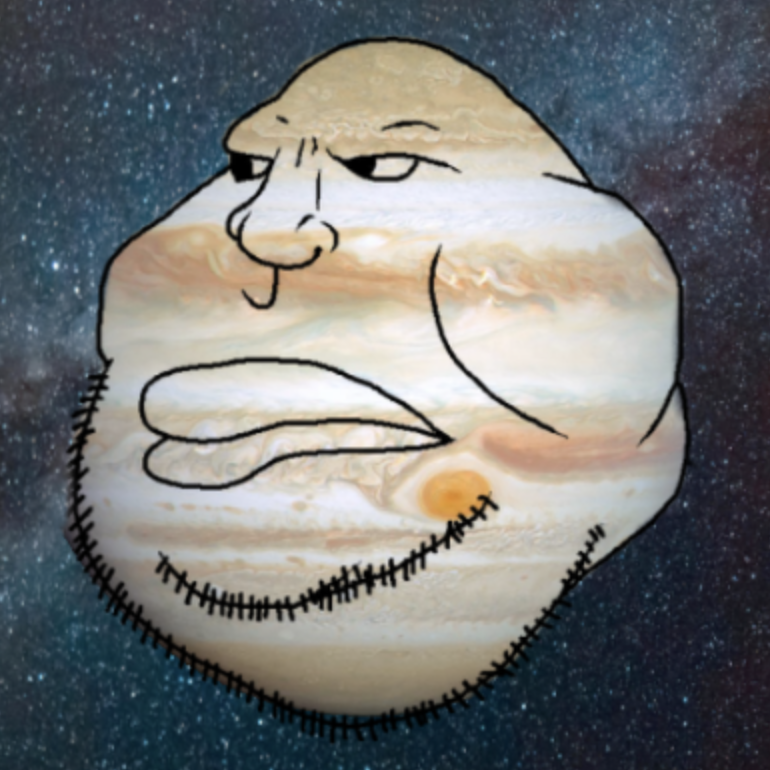
Jupiter: located between 4.95 and 5.46 AU away from the Sun, and named after the king of the gods in Roman mythology, Jupiter is the biggest and the most massive planet in the solar system (11 times bigger than the Earth) and due to it's very fast rotation is one of the fattest planets in the solar system (the (((Jews))) want to steal the planet and often like to nickname it ((("Jewpiter"))) as their own due to how similar it sounds). On its surface, there are orange-brown and white cloud bands moving via the principles of atmospheric circulation, with giant storms swirling on the surface such as the Great Red Spot and white 'ovals'. Jupiter possesses a strong enough magnetosphere to redirect ionizing radiation and cause auroras on its poles. As of 2026, Jupiter has 101 confirmed satellites, which can roughly be sorted into three groups:
The Amalthea group, consisting of four small SNCA satellites named Metis, Adrastea, Amalthea, and Thebe. They orbit substantially closer to Jupiter than other satellites. Materials from these natural satellites are the source of Jupiter's faint ring.
the Galilean moons, consisting of Ganymede, Callisto, Io, and Europa. They are the largest moons of Jupiter and exhibit planetary properties.
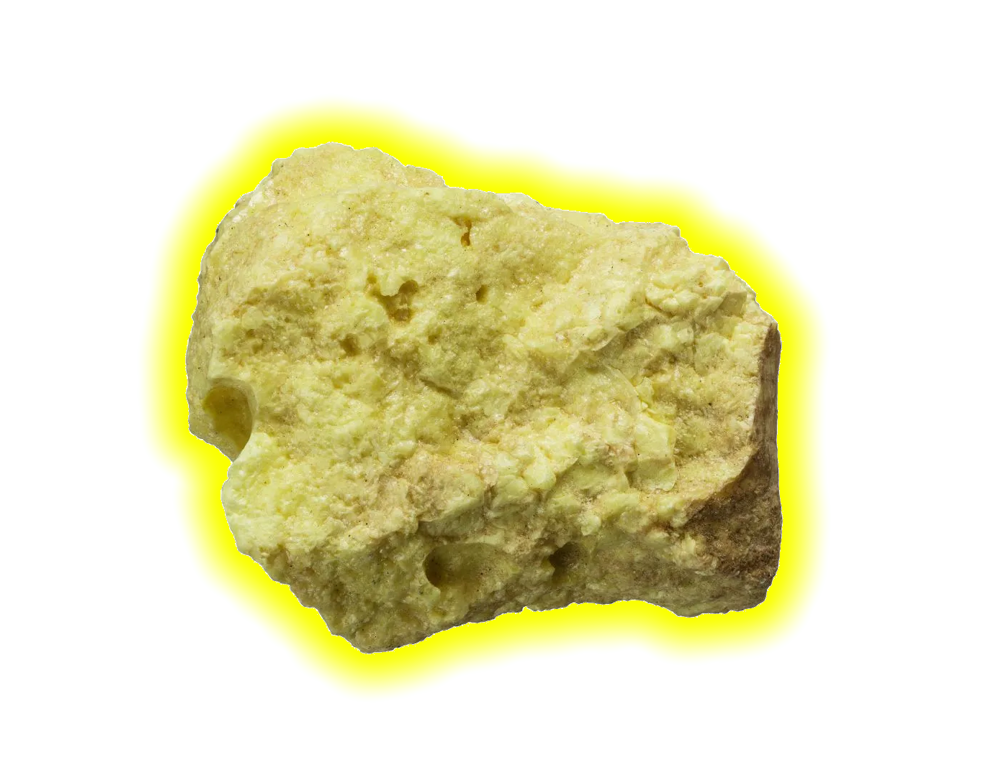
Io: (also called Niggerhell proper), is the innermost of the Galilean moons, with the greatest amount of brimstone anywhere in the solar system, it is a place that should be avoided at all costs (death within 3 seconds can occur on individuals retarded enough to visit it.) Here, on this moon, trannies, niggers, pedos, furries, vorefags, nsfw artists, commies, the sexually immoral, and the souls of the damned burn here for eternity, and it is where niggerhell sites such as DeviantArt and FurAffinity are secretly headquartered in. Io has about 400 active volcanoes with it's extreme geologic activity resulting from tidal heating and friction generated within it's interior as it is pulled and stretched by Jupiter and two other moons, Europa and Ganymede. Several volcanoes produce plumes of sulfur and sulfur dioxide as high as 500 km (300 mi) above the surface. Io's surface is also dotted with more than 100 mountains uplifted by extensive compression at the base of Io's silicate crust. Some of these peaks are taller than Mount Everest, the highest point on Earth's surface. Unlike most moons in the outer Solar System, which are mostly composed of water ice, Io is primarily composed of silicate rock surrounding a molten iron or iron sulfide core. Most of Io's surface is composed of extensive plains with a frosty coating of sulfur (brimstone) and sulfur dioxide.
Europa: A planetary mass moon slightly smaller than Earth's moon, it is an icy moon like Ganymede and Callisto and like Io experiences extreme tidal effects that cause it to be cryovolcanically active. It has a subsurface ocean that might possibly house ALIEN LIFE, though we do not know for sure. YOU VVILL FIND OUT!!! (It shares a similar name with Europe, the continent from back home on Earth).
Ganymede: Another icy moon, it is the largest moon in the solar system, it is even bigger than Mercury but less massive due to it's icy composition. And is the outermost of the three moons partaking in the 1:2:4 orbital resonance (alongside Io and Europa).
Callisto: (or Chudheaven), is the closest extraterrestrial analog to Hyperborea, and is even a province of it. Callisto is a geologically dead moon and houses many impact craters, one of which is called Vallhala, the heaven place for the Aryans and the most well respected. Callisto is icy just like Europa and Ganymede and it has a subsurface ocean. Located on the Loki crater is another outpost of Sneed's Feed and Seed.
Irregular satellites, consisting of substantially smaller natural satellites. They have more distant orbits than the other objects. The biggest of which is named Himalia.
Saturn: located between 9.08 and 10.12 AU away from the Sun. It is the second largest planet in the solar system and one of the fattest (only behind Jupiter). Saturn itself is named after the king of the titans and the agriculture god from Roman mythology though he ate his own children. Saturn has a distinctive visible ring system orbiting around its equator composed of small ice and rock particles, giving it the nickname, the "Jewel of the Soylar System". Like Jupiter, it is mostly made of hydrogen and helium. At its north and south poles, Saturn has peculiar hexagon-shaped storms larger than the diameter of Earth. Saturn has a magnetosphere capable of producing weak auroras. As of 2026, Saturn has 285 confirmed satellites, grouped into:
Ring moonlets and shepherds, which orbit inside or close to Saturn's rings. A moonlet can only partially clear out dust in its orbit, while the ring shepherds are able to completely clear out dust, forming visible gaps in the rings.
Inner large satellites Mimas (which looks like heckin Death Star), Enceladus (a potentially habitable world), Tethys, and Dione. These satellites orbit within Saturn's E ring. They are composed mostly of water ice and are believed to have differentiated internal structures.
Trojan moons Calypso and Telesto (trojans of Tethys), and Helene and Polydeuces (trojans of Dione). These small moons share their orbits with Tethys and Dione, leading or trailing either.
Outer large satellites Rhea, Titan, Hyperion, and Iapetus. Titan in particular is the only satellite in the Solar System to have a substantial atmosphere. being bigger than Mercury, and strongly resembling the early Earth, another life-filled chemical world.
Irregular satellites, consisting of substantially smaller natural satellites. They have more distant orbits than the other objects. Phoebe is the largest irregular satellite of Saturn.
The Missing Thremboth Planet: (also known as the Fifth Giant by the soyentists.) a hypothetical ice giant planet that could exist somewhere in the galaxy now wandering as a rogue planet. According to the logic of the average soyteen's mind, in order to fulfill the spirit of the hidden number Thrembo, there should be a thremboth planet existing in the space between Saturn and Uranus. No such planet exists, and if it was present, it likely was an ice giant similar in size to Uranus or Neptune. It likely had a mass between 10 and 20 times that of Earth's, and it probably had ███ moons in orbit. The ejection of the missing thremboth planet is believed to have occurred during the early Solar System's period of instability, when gravitational interactions between the giant planets became chaotic. The planet likely encountered a series of close gravitational encounters with Jupiter or Saturn, resulting in its eventual expulsion from the Solar System. Such an event would have minimized the disruption to the orbits of the remaining planets while aligning with constraints derived from their current orbital architecture. After it's sad ejection, it was sent wandering in the depths of space. On July 22nd, 20ϪϪ, an expedition was launched from SoySpace to try to find the missing thremboth planet somewhere in the galaxy. It might be somewhere in the constellation of ███████, who knows? Unfortunately, the CIA stops us from trying to know about it so you better watch out for the little green glowing men. Thankfully, centaurs such as 2060 Chiron are a replacement for the missing thremboth planet.
Uranus: no, don't try to laugh, it's not your-AY-nus, its yur-uh-nus. It is named after the Greek god of the sky. It is located between 18.3 and 20.1 AU away from the Sun. as the seventh planet from the sun, it stands uniquely among the planets, as it orbits the Sun while rotating on its side with an axial tilt of about >90°. This gives the planet extreme seasonal variation as each pole points alternately toward and then away from the Sun. Uranus's outer layer has a muted cyan color, but underneath these clouds are many mysteries about its climate, such as unusually low internal heat and erratic cloud formation. As of 2026, Uranus has 29 confirmed satellites, divided into three groups:
Inner satellites, which orbit inside Uranus's ring system. They are very close to each other, which suggests that their orbits are chaotic.
Large satellites, consisting of Titania, Oberon, Umbriel, Ariel, and Miranda. Most of them have roughly equal amounts of rock and ice, except Miranda, which is made primarily of ice.
Irregular satellites, having more distant and eccentric orbits than the other objects.
Neptune: is located between 29.9 and 30.5 AU away from the Sun. It is named after the Roman god of the oceans. Neptune is the furthest planet known in the Solar System. Its outer atmosphere has a slightly muted cyan color, with occasional storms on the surface that look like dark spots. Like Uranus, many atmospheric phenomena of Neptune are unexplained, such as the thermosphere's abnormally high temperature or the strong tilt (47°) of its magnetosphere. As of 2026, Neptune has 16 confirmed satellites, divided into two groups:
Regular satellites, which have circular orbits that lie near Neptune's equator.
Irregular satllites, which as the name implies, have less regular orbits. One of them, Triton, is Neptune's largest moon. It is geologically active, with erupting geysers of nitrogen gas, and possesses a thin, cloudy nitrogen atmosphere.
The centaurs are icy, comet-like bodies whose semi-major axes are longer than Jupiter's and shorter than Neptune's (between 5.5 and 30 AU). These are former Kuiper belt and scattered disc objects (SDOs) that were gravitationally perturbed closer to the Sun by the outer planets, and are expected to become comets or be ejected out of the Solar System. While most centaurs are inactive and asteroid-like, some exhibit cometary activity, such as the first centaur discovered, 2060 Chiron (the replacement thremboth planet), which has been classified as a comet (95P) because it develops a coma just as comets do when they approach the Sun. The largest known centaur, 10199 Chariklo, has a diameter of about 250 km (160 mi) and is one of the few minor planets possessing a ring system.
Beyond the orbit of Neptune lies the area of the "trans-Neptunian region" (though thankfully it's not related to trannies, which are degenerate subhumans), with the doughnut-shaped Kuiper belt, home of Pluto and several other dwarf planets, and an overlapping disc of scattered objects, which is tilted toward the plane of the Solar System and reaches much further out than the Kuiper belt. The entire region is still largely unexplored. It appears to consist overwhelmingly of many thousands of small worlds – the largest having a diameter only a fifth that of Earth and a mass far smaller than that of the Moon – composed mainly of rock and ice. This region is sometimes described as the "third zone of the Solar System", enclosing the inner and the outer Solar System.
The Kuiper belt (named after the Dutch astronomer Gerard Kuiper) is a great ring of debris similar to the asteroid belt, but consisting mainly of objects composed primarily of ice. It extends between 30 and 50 AU from the Sun. It is composed mainly of small Solar System bodies, although the largest few are probably large enough to be dwarf planets. There are estimated to be over 100,000 Kuiper belt objects with a diameter greater than 50 km, but the total mass of the Kuiper belt is thought to be only a tenth or even a hundredth the mass of Earth. Many Kuiper belt objects have satellites, and most have orbits that are substantially inclined (~10°) to the plane of the ecliptic.
The Kuiper belt can be roughly divided into the "classical" belt and the resonant trans-Neptunian objects. The latter have orbits whose periods are in a simple ratio to that of Neptune: for example, going around the Sun twice for every three times that Neptune does, or once for every two. The classical belt consists of objects having no resonance with Neptune, and extends from roughly 39.4 to 47.7 AU. Members of the classical Kuiper belt are sometimes called "cubewanos" or "Albionians", after the first of their kind to be discovered, originally designated 1992 QB1, (and has since been named 15670 Albion); they are still in near primordial, low-eccentricity orbits.
There is strong consensus among astronomers that five members of the Kuiper belt are dwarf planets. Many dwarf planet candidates are being considered, pending further data for verification.
134340 Pluto: located between 29.7 and 49.3 AU away from the Sun, is the largest known object in the Kuiper belt (it was formerly considered the ninth planet from the Sun from it's discovery by Clyde Tombaugh in 1930 until the (((IAU))) demoted it to a dwarf planet in 2006). Being named after the Roman god for Niggerhell, Pluto has a relatively eccentric orbit, inclined 17 degrees to the ecliptic plane. Pluto has a 2:3 resonance with Neptune, meaning that Pluto orbits twice around the Sun for every three Neptunian orbits. Kuiper belt objects whose orbits share this resonance are called plutinos. Pluto has five moons: Charon, Styx, Nix, Kerberos, and Hydra. Pluto WABAP (Will Always Be A Planet).
Charon: is the largest of Pluto's moons, and is sometimes described as part of a binary system with Pluto, as the two bodies orbit a barycenter of gravity above their surfaces (i.e. they appear to "orbit each other" (binary dwarf planet award)).
90482 Orcus: located between 30.3 and 48.1 AU away from the Sun. It is in the same 2:3 orbital resonance with Neptune as Pluto, and is the largest such object after Pluto itself. Its eccentricity and inclination are similar to Pluto's, but its perihelion lies about 120° from that of Pluto. Thus, the phase of Orcus's orbit is opposite to Pluto's: Orcus is at aphelion (most recently in 2019) around when Pluto is at perihelion (most recently in 1989) and vice versa. For this reason, it has been called the anti-Pluto (uh oh, it looks like Orcus might be an outpost of Poopson, everyone RUN!!!). It has one known moon, Vanth.
136108 Haumea: located between 34.6 and 51.6 AU away from the Sun, was discovered in 2005. It is in a temporary 7:12 orbital resonance with Neptune. Haumea possesses a ring system, two known moons named Hiʻiaka and Namaka (weird Polynesian SEAMonkey names), and rotates so quickly (once every 3.9 hours) that it is stretched into an ellipsoid (egg-shaped planet award). It is part of a collisional family of Kuiper belt objects that share similar orbits, which suggests a giant impact on Haumea ejected fragments into space billions of years ago.
136472 Makemake (another stupid SEAMonkey name): located between 38.1 and 52.8 AU away from the Sun, is although smaller than Pluto, is the largest known object in the classical Kuiper belt (that is, a Kuiper belt object not in a confirmed resonance with Neptune). Makemake is the brightest object in the Kuiper belt after Pluto. Discovered in 2005, it was officially named in 2009. Its orbit is far more inclined than Pluto's, at 29°. It has one known moon, S/2015 (136472) 1.
50000 Quaoar: located between 41.9 and 45.5 AU away from the Sun. is the second-largest known object in the classical Kuiper belt, after Makemake. Its orbit is significantly less eccentric and inclined than those of Makemake or Haumea. It possesses a ring system and one known moon, Weywot. Quaoar is an extremely stupid SNCA dwarf planet because it's name is from ugly Native American shitty redskin people.
The scattered disc (beware, do not go beyond), which overlaps the Kuiper belt but extends out to near 500 AU, is thought to be the source of short-period comets. Scattered-disc objects are believed to have been perturbed into erratic orbits by the gravitational influence of Neptune's early outward migration (failnuke). Most scattered disc objects have perihelia within the Kuiper belt but aphelia far beyond it (some more than 150 AU from the Sun). SDOs' orbits can be inclined up to 46.8° from the ecliptic plane. Some astronomers consider the scattered disc to be merely another region of the Kuiper belt and describe scattered-disc objects as "scattered Kuiper belt objects". Some astronomers classify centaurs as inward-scattered Kuiper belt objects along with the outward-scattered residents of the scattered disc.
Currently, there is strong consensus among astronomers that two of the bodies in the scattered disc are dwarf planets:
136199 Eris: (formerly known as Xena[THANK GOD THE NAME GOT RETIRED]), located between 38.3 and 97.5 AU away from the Sun, is the largest known scattered disc object and the most massive known dwarf planet. Eris's discovery contributed to a debate about the definition of a planet because it is 25% more massive than Pluto and about the same diameter. It has one known moon, Dysnomia. Like Pluto, its orbit is highly eccentric, with a perihelion of 38.2 AU (roughly Pluto's distance from the Sun) and an aphelion of 97.6 AU, and steeply inclined to the ecliptic plane at an angle of 44°. (Wooh, this dwarf planet is taking us on a far journey to the deep depths of nothing award.)
225088 Gonggong: located between 33.8 and 101.2 AU away from the Sun. Gonggong has one of the stupidest names and because it is named after a Chinkmonster from chinky chinky chinky mythology, it smells incredibly AWFUL!!!! Gonggong is a dwarf planet in a comparable orbit to Eris, except that it is in a 3:10 resonance with Neptune. It has one known moon, Xiangliu (which smells like smelly stinky chink feet).
Gǃkúnǁʼhòmdímà: This name looks like retarded niggerbabble, because it literally is. It's named after a goddess of an SNCA tribe in Namibia. It has a moon with an equally retarded name (Gǃòʼé ǃHú).
Some objects in the Solar System have a very large orbit, and therefore are much less affected by the known giant planets than other minor planet populations. These bodies are called extreme trans-Neptunian objects, or ETNOs for short. Generally, ETNOs' semi-major axes are at least 150–250 AU wide. For example, 541132 Leleākūhonua (smelly Polynesian feet world) orbits the Sun once every ~32,000 years, with a distance of 65–2000 AU from the Sun.
This population is divided into three subgroups by astronomers. The scattered ETNOs have perihelia around 38–45 AU and an exceptionally high eccentricity of more than 0.85. As with the regular scattered disc objects, they were likely formed as result of gravitational scattering by Neptune and still interact with the giant planets. The detached ETNOs, with perihelia approximately between 40–45 and 50–60 AU, are less affected by Neptune than the scattered ETNOs, but are still relatively close to Neptune. The sednoids or inner Oort cloud objects, with perihelia beyond 50–60 AU, are too far from Neptune to be strongly influenced by it.
Currently, there is one ETNO that is classified as a dwarf planet:
90377 Sedna: located between 76.2 and a HOLY FUCKING 937 AU AWAY FROM THE SUN (WAY TOO FAR)!!! Sedna was the first extreme trans-Neptunian object to be discovered. It is a large, reddish object, and takes ~11,400 years to complete one orbit (way too long). Mike Brown, who discovered the object in 2003, asserts that it cannot be part of the scattered disc or the Kuiper belt because its perihelion is too distant to have been affected by Neptune's migration. The sednoid population is named after Sedna. Here on Sedna, because it's an Inuit name, there is a portal leading to here where a single building exists where all the Mongoloidchinks, japs, gooks, Indigenous Siberians and American Indians, Spics, SEAmonkeys, and Polynesians gather for their disgusting little feet fetish shows.
The O̸̟͓̽̾̓̉͌͝O̴̩͉̥͉̥͉͖͎͙͖͂̿͗̑̑́̉̾͊́͌͆̚͠͠R̶̪̰̬͚̟̐̄͒̔̋̅͐̀́͒̕̚͝͝͝T̶̜̠͈̺̂͛̿̃̓̓̌́̀̂͆̚͘ ̷̨̳̟͍̥͎̜̳̭͙͎͑̓͠C̴̨̢̱͙̯̥̤̯̝̤̺̜̼͖̃̈́L̸̛̜̤̻̹̉̕ͅO̶̬̜̹͑̈́̌͛̐̐̾͛́͑̕͝͠ͅŲ̴̢̛̛̫̠͔͚̗̠̹͕̭̰͙̞̭͛́̈́̐́͛͂̓̇̉͊̊Ḑ̵͚̟̜̼̲̫̣̦̱̞͈̬̩̥̽̌̈́̂͐̀͗̍̎͒̈́ is a theorized spherical shell of up to a trillion icy objects that is thought to be the source for all long-period comets, which were originally ejected from the planetary region by gravitational interactions with the gas giants. O̸̟͓̽̾̓̉͌͝O̴̩͉̥͉̥͉͖͎͙͖͂̿͗̑̑́̉̾͊́͌͆̚͠͠R̶̪̰̬͚̟̐̄͒̔̋̅͐̀́͒̕̚͝͝͝T̶̜̠͈̺̂͛̿̃̓̓̌́̀̂͆̚͘ ̷̨̳̟͍̥͎̜̳̭͙͎͑̓͠C̴̨̢̱͙̯̥̤̯̝̤̺̜̼͖̃̈́L̸̛̜̤̻̹̉̕ͅO̶̬̜̹͑̈́̌͛̐̐̾͛́͑̕͝͠ͅŲ̴̢̛̛̫̠͔͚̗̠̹͕̭̰͙̞̭͛́̈́̐́͛͂̓̇̉͊̊Ḑ̵͚̟̜̼̲̫̣̦̱̞͈̬̩̥̽̌̈́̂͐̀͗̍̎͒̈́ objects move very slowly, and can be perturbed by infrequent events, such as collisions, the gravitational effects of a passing star, or the galactic tide, the tidal force exerted by the Milky Way. No direct observation of the O̸̟͓̽̾̓̉͌͝O̴̩͉̥͉̥͉͖͎͙͖͂̿͗̑̑́̉̾͊́͌͆̚͠͠R̶̪̰̬͚̟̐̄͒̔̋̅͐̀́͒̕̚͝͝͝T̶̜̠͈̺̂͛̿̃̓̓̌́̀̂͆̚͘ ̷̨̳̟͍̥͎̜̳̭͙͎͑̓͠C̴̨̢̱͙̯̥̤̯̝̤̺̜̼͖̃̈́L̸̛̜̤̻̹̉̕ͅO̶̬̜̹͑̈́̌͛̐̐̾͛́͑̕͝͠ͅŲ̴̢̛̛̫̠͔͚̗̠̹͕̭̰͙̞̭͛́̈́̐́͛͂̓̇̉͊̊Ḑ̵͚̟̜̼̲̫̣̦̱̞͈̬̩̥̽̌̈́̂͐̀͗̍̎͒̈́ is possible with present imaging technology. (WARNING: DO NOT VISIT THE O̸̟͓̽̾̓̉͌͝O̴̩͉̥͉̥͉͖͎͙͖͂̿͗̑̑́̉̾͊́͌͆̚͠͠R̶̪̰̬͚̟̐̄͒̔̋̅͐̀́͒̕̚͝͝͝T̶̜̠͈̺̂͛̿̃̓̓̌́̀̂͆̚͘ ̷̨̳̟͍̥͎̜̳̭͙͎͑̓͠C̴̨̢̱͙̯̥̤̯̝̤̺̜̼͖̃̈́L̸̛̜̤̻̹̉̕ͅO̶̬̜̹͑̈́̌͛̐̐̾͛́͑̕͝͠ͅŲ̴̢̛̛̫̠͔͚̗̠̹͕̭̰͙̞̭͛́̈́̐́͛͂̓̇̉͊̊Ḑ̵͚̟̜̼̲̫̣̦̱̞͈̬̩̥̽̌̈́̂͐̀͗̍̎͒̈́ OR YOU WILL GET LOST FOR ETERNITY)
The O̸̟͓̽̾̓̉͌͝O̴̩͉̥͉̥͉͖͎͙͖͂̿͗̑̑́̉̾͊́͌͆̚͠͠R̶̪̰̬͚̟̐̄͒̔̋̅͐̀́͒̕̚͝͝͝T̶̜̠͈̺̂͛̿̃̓̓̌́̀̂͆̚͘ ̷̨̳̟͍̥͎̜̳̭͙͎͑̓͠C̴̨̢̱͙̯̥̤̯̝̤̺̜̼͖̃̈́L̸̛̜̤̻̹̉̕ͅO̶̬̜̹͑̈́̌͛̐̐̾͛́͑̕͝͠ͅŲ̴̢̛̛̫̠͔͚̗̠̹͕̭̰͙̞̭͛́̈́̐́͛͂̓̇̉͊̊Ḑ̵͚̟̜̼̲̫̣̦̱̞͈̬̩̥̽̌̈́̂͐̀͗̍̎͒̈́ is theorized to surround the Solar System from potentially ~2,000 AU from the Sun to up to ~200,000 AU. Lower estimates for the radius of the O̸̟͓̽̾̓̉͌͝O̴̩͉̥͉̥͉͖͎͙͖͂̿͗̑̑́̉̾͊́͌͆̚͠͠R̶̪̰̬͚̟̐̄͒̔̋̅͐̀́͒̕̚͝͝͝T̶̜̠͈̺̂͛̿̃̓̓̌́̀̂͆̚͘ ̷̨̳̟͍̥͎̜̳̭͙͎͑̓͠C̴̨̢̱͙̯̥̤̯̝̤̺̜̼͖̃̈́L̸̛̜̤̻̹̉̕ͅO̶̬̜̹͑̈́̌͛̐̐̾͛́͑̕͝͠ͅŲ̴̢̛̛̫̠͔͚̗̠̹͕̭̰͙̞̭͛́̈́̐́͛͂̓̇̉͊̊Ḑ̵͚̟̜̼̲̫̣̦̱̞͈̬̩̥̽̌̈́̂͐̀͗̍̎͒̈́, by contrast, do not place it farther than 50,000 AU. Most of the mass is orbiting in the region between 3,000 and 100,000 AU. The furthest known objects, such as Comet West (C/1975 V1), have aphelia around 70,000 AU from the Sun.
Stuff possibly related to the O̸̟͓̽̾̓̉͌͝O̴̩͉̥͉̥͉͖͎͙͖͂̿͗̑̑́̉̾͊́͌͆̚͠͠R̶̪̰̬͚̟̐̄͒̔̋̅͐̀́͒̕̚͝͝͝T̶̜̠͈̺̂͛̿̃̓̓̌́̀̂͆̚͘ ̷̨̳̟͍̥͎̜̳̭͙͎͑̓͠C̴̨̢̱͙̯̥̤̯̝̤̺̜̼͖̃̈́L̸̛̜̤̻̹̉̕ͅO̶̬̜̹͑̈́̌͛̐̐̾͛́͑̕͝͠ͅŲ̴̢̛̛̫̠͔͚̗̠̹͕̭̰͙̞̭͛́̈́̐́͛͂̓̇̉͊̊Ḑ̵͚̟̜̼̲̫̣̦̱̞͈̬̩̥̽̌̈́̂͐̀͗̍̎͒̈́ include:
Planet Nine: (also called Erebus), the hypothetical planet that might exist somewhere between 200 and 800 AU away from the Sun. the mysterious hypothetical planet is expected to be located within the O̸̟͓̽̾̓̉͌͝O̴̩͉̥͉̥͉͖͎͙͖͂̿͗̑̑́̉̾͊́͌͆̚͠͠R̶̪̰̬͚̟̐̄͒̔̋̅͐̀́͒̕̚͝͝͝T̶̜̠͈̺̂͛̿̃̓̓̌́̀̂͆̚͘ ̷̨̳̟͍̥͎̜̳̭͙͎͑̓͠C̴̨̢̱͙̯̥̤̯̝̤̺̜̼͖̃̈́L̸̛̜̤̻̹̉̕ͅO̶̬̜̹͑̈́̌͛̐̐̾͛́͑̕͝͠ͅŲ̴̢̛̛̫̠͔͚̗̠̹͕̭̰͙̞̭͛́̈́̐́͛͂̓̇̉͊̊Ḑ̵͚̟̜̼̲̫̣̦̱̞͈̬̩̥̽̌̈́̂͐̀͗̍̎͒̈́'s inner zone. Who cares, who understands? Is this planet real? Maybe or maybe not or something. But oh shit, if we want to go find out, the CIA never lets us go within 50 AU of it's expected location. Planet Nine might be the home of Poopson, or be located at the very unknowns of the depths of Niggerhell or on Admin 6's bottomless pit. It's likely an ice giant planet similar to Uranus and Neptune. And could probbaly influence Sedna's orbit. One theory suggests it may have formed closer but got ejected out by Jupiter, another theory is that it was a captured rogue planet. But this paranormal object probably exists somewhere in the depths of the constellation of █████, perhaps, we will never know. It might be made of ███████, or █████, it probably has a mass of ██ times that of Earth's. It will likely have ███ natural satellites in orbit. Maybe send another SoySpace expedition to find out.
Nemesis: is the informal name of WISE 0720−0846, or "Scholz's Star", it is a red dwarf star located about 22 light years away from the Sun in the constellation of Monoceros. It is a binary system, as the star has a brown dwarf companion informally named "Tyche" (sounds so similar to dyke haha get it, dyke world?), both names were used for hypothetical objects located somewhere in the outer limits of the O̸̟͓̽̾̓̉͌͝O̴̩͉̥͉̥͉͖͎͙͖͂̿͗̑̑́̉̾͊́͌͆̚͠͠R̶̪̰̬͚̟̐̄͒̔̋̅͐̀́͒̕̚͝͝͝T̶̜̠͈̺̂͛̿̃̓̓̌́̀̂͆̚͘ ̷̨̳̟͍̥͎̜̳̭͙͎͑̓͠C̴̨̢̱͙̯̥̤̯̝̤̺̜̼͖̃̈́L̸̛̜̤̻̹̉̕ͅO̶̬̜̹͑̈́̌͛̐̐̾͛́͑̕͝͠ͅŲ̴̢̛̛̫̠͔͚̗̠̹͕̭̰͙̞̭͛́̈́̐́͛͂̓̇̉͊̊Ḑ̵͚̟̜̼̲̫̣̦̱̞͈̬̩̥̽̌̈́̂͐̀͗̍̎͒̈́. Perhaps, about 70,000 years ago, the star and it's brown dwarf companion was briefly part of the solar system because it entered the O̸̟͓̽̾̓̉͌͝O̴̩͉̥͉̥͉͖͎͙͖͂̿͗̑̑́̉̾͊́͌͆̚͠͠R̶̪̰̬͚̟̐̄͒̔̋̅͐̀́͒̕̚͝͝͝T̶̜̠͈̺̂͛̿̃̓̓̌́̀̂͆̚͘ ̷̨̳̟͍̥͎̜̳̭͙͎͑̓͠C̴̨̢̱͙̯̥̤̯̝̤̺̜̼͖̃̈́L̸̛̜̤̻̹̉̕ͅO̶̬̜̹͑̈́̌͛̐̐̾͛́͑̕͝͠ͅŲ̴̢̛̛̫̠͔͚̗̠̹͕̭̰͙̞̭͛́̈́̐́͛͂̓̇̉͊̊Ḑ̵͚̟̜̼̲̫̣̦̱̞͈̬̩̥̽̌̈́̂͐̀͗̍̎͒̈́, possibly gravitationally disrupting the path some comets along the way, it's possible that whatever comets this star sent WILL reach the inner solar system in about 1 to 2 million years from now.
Solid objects smaller than one meter are usually called meteoroids and micrometeoroids (grain-sized), with the exact division between the two categories being debated over the years. By 2017, the IAU designated any solid object having a diameter between ~30 micrometers and 1 meter as meteoroids, and depreciated the micrometeoroid categorization, instead terms smaller particles simply as 'dust particles' (stupid little stinky dust particles).
Some of these dirty stinky rocks you guys call "meteoroids" formed via disintegration of comets and asteroids, while a few formed via impact debris ejected from planetary bodies. Most meteoroids are made of silicates and heavier metals like nickel and iron. When passing through the Solar System, comets produce a trail of meteoroids; it is hypothesized that this is caused either by vaporization of the comet's material or by simple breakup of dormant comets. When crossing an atmosphere, these meteoroids will produce bright streaks in the sky due to atmospheric entry, called meteors. If a stream of meteoroids enter the atmosphere on parallel trajectories, the meteors will seemingly 'radiate' from a point in the sky, hence the phenomenon's name: meteor shower (or shooting star shower, or whatever).
The inner Solar System is home to the zodiacal dust cloud, which is visible as the hazy zodiacal light in dark, unpolluted skies. It may be generated by collisions within the asteroid belt brought on by gravitational interactions with the planets; a more recent proposed origin is materials from planet Mars. The outer Solar System hosts a cosmic dust cloud. It extends from about 10 AU to about 40 AU, and was probably created by collisions within the Kuiper belt.
Comets (also called icesteroids, gasteroids, dirty snowball shit, or shitballs) are small Solar System bodies just like minor planets or asteroids, typically only a few kilometers across, composed largely of volatile ices (ooooh, hidden gems and life). They have highly eccentric orbits, generally a perihelion within the orbits of the inner planets and an aphelion far beyond Pluto. When a comet enters the inner Solar System, its proximity to the Sun causes its icy surface to sublimate and ionise, creating a coma: a long tail of gas and dust often visible to the naked eye.
Short-period comets have orbits lasting less than two hundred years. Long-period comets have orbits lasting thousands of years. Short-period comets are thought to originate in the Kuiper belt, whereas long-period comets, such as Hale–Bopp, are thought to originate in the O̸̟͓̽̾̓̉͌͝O̴̩͉̥͉̥͉͖͎͙͖͂̿͗̑̑́̉̾͊́͌͆̚͠͠R̶̪̰̬͚̟̐̄͒̔̋̅͐̀́͒̕̚͝͝͝T̶̜̠͈̺̂͛̿̃̓̓̌́̀̂͆̚͘ ̷̨̳̟͍̥͎̜̳̭͙͎͑̓͠C̴̨̢̱͙̯̥̤̯̝̤̺̜̼͖̃̈́L̸̛̜̤̻̹̉̕ͅO̶̬̜̹͑̈́̌͛̐̐̾͛́͑̕͝͠ͅŲ̴̢̛̛̫̠͔͚̗̠̹͕̭̰͙̞̭͛́̈́̐́͛͂̓̇̉͊̊Ḑ̵͚̟̜̼̲̫̣̦̱̞͈̬̩̥̽̌̈́̂͐̀͗̍̎͒̈́. Many comet groups, such as the Kreutz sungrazers, formed from the breakup of a single parent. Some comets with hyperbolic orbits may originate outside the Solar System, but determining their precise orbits is difficult. Old comets whose volatiles have mostly been driven out by solar warming are often categorized as asteroids.


.png)
.png)
.jpg)