Mirror
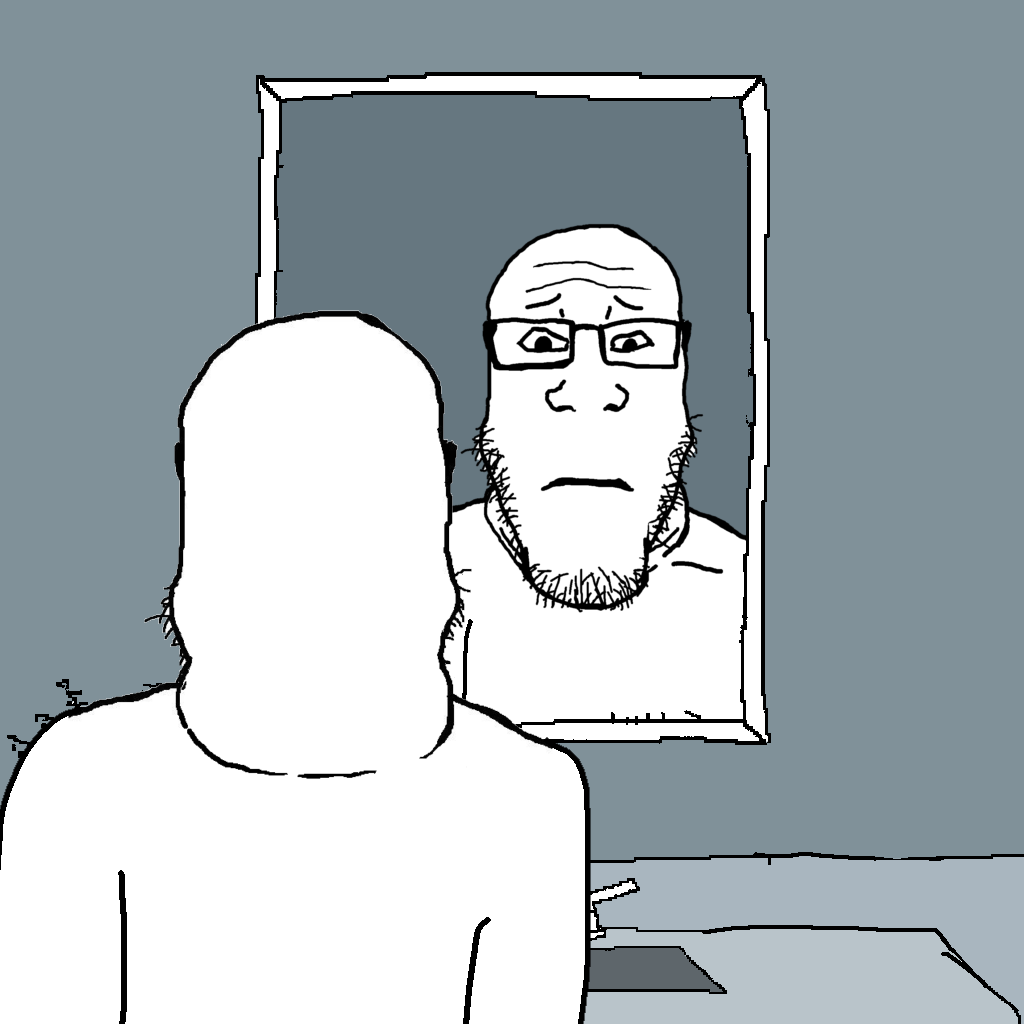
A mirror is an object that reflects an image of whatever is in front of it. According to soyence, this happens due to the light bouncing off the mirror, which is then focused through the lens of the viewer's eyes or camera. This is especially helpful for people like you, where you can inspect your looks and prevent people calling you an ugly troon or something like that.
Another use mirrors have is that they often show objects behind the viewer that would be out of their field of view, providing valuable info to the viewer that they wouldn't have. This can be seen being used in rear-view windows in vehicles, dentist’s mirrors and some types of telescopes.
Mirrors can also be found naturally, like on water, rocks, metals, crystals, etc. Nowadays, mirrors are created by using a flat piece of glass and applying a thin coating of aluminium or silver.

History
[edit | edit source]Prehistory
[edit | edit source]The first mirrors to be used by humans were likely pools of still water or shiny stones. The earliest man-made mirrors were polished pieces of obsidian made by Turkroachs in Çatalhöyük dating back to 6000 BC. From 4000 BC, polished copper mirrors were made in Mesopotamia while from around 3000 BC in Ancient Egypt. Polished stone mirrors were also found in Central and South America from 2000 BC onward.
Bronze Age to Middle Ages
[edit | edit source]By the Bronze Age, most groups had begun using polished bronze, copper, silver or other metals to make mirrors, with the Kerma culture in Nubia being skilled at making them and the earliest pieces of Bronze and Copper mirrors were found in China from around 2000BC. It was common for mirrors to become tarnished and required to be polished frequently.It wasn’t until the 1st century that glass mirrors coated in lead or gold began to be produced, providing better reflectivity than bronze and reduced tarnishing.
Middle Ages and Renaissance
[edit | edit source]Coming into the Middle Ages, improvements were made to glassmaking. In France, glassmakers made flat glass plates by blowing glass bubbles, spinning them quickly to flatten them, and cutting rectangles out of them. In Germany, a better method was found and perfected in Venice. The method was to blow a cylinder of glass, cut off the ends, slice it along its length, then unroll it onto a flat hot plate.
In the Early Renaissance, a fire-gliding technique was used to create even and highly reflective tin coatings for glass mirrors while the back of glass was coated in a tin-mercury amalgam before heating up the piece to evaporate the mercury. Venetian mirrors would be used in palaces throughout and were very expensive, providing Venice lots of money. It was until the end of the century that the secret was leaked and French workshops mass produced them, making them affordable.
Industrial Revolution
[edit | edit source]In the late Industrial Revolution, the invention of the ribbon machine made it that modern glass panes could be produced in bulk. The Saint-Gobain factory and Bohemian and German Glass became important manufacturers from this method.
The invention of silvered-glass by German chemist Justav von Liebig in 1835 led to his process being adapted to mass-produced mirrors and made them more affordable.




A mirror is an object that reflects an image of whatever is in front of it. According to soyence, this happens due to the light bouncing off the mirror, which is then focused through the lens of the viewer's eyes or camera. This is especially helpful for people like you, where you can inspect your looks and prevent people calling you an ugly troon or something like that.
Another use mirrors have is that they often show objects behind the viewer that would be out of their field of view, providing valuable info to the viewer that they wouldn't have. This can be seen being used in rear-view windows in vehicles, dentist’s mirrors and some types of telescopes.
Mirrors can also be found naturally, like on water, rocks, metals, crystals, etc. Nowadays, mirrors are created by using a flat piece of glass and applying a thin coating of aluminium or silver.
History
[edit | edit source]Prehistory
[edit | edit source]The first mirrors to be used by humans were likely pools of still water or shiny stones. The earliest man-made mirrors were polished pieces of obsidian made by Turkroachs in Çatalhöyük dating back to 6000 BC. From 4000 BC, polished copper mirrors were made in Mesopotamia while from around 3000 BC in Ancient Egypt. Polished stone mirrors were also found in Central and South America from 2000 BC onward.
Bronze Age to Middle Ages
[edit | edit source]By the Bronze Age, most groups had begun using polished bronze, copper, silver or other metals to make mirrors, with the Kerma culture in Nubia being skilled at making them and the earliest pieces of Bronze and Copper mirrors were found in China from around 2000BC. It was common for mirrors to become tarnished and required to be polished frequently.It wasn’t until the 1st century that glass mirrors coated in lead or gold began to be produced, providing better reflectivity than bronze and reduced tarnishing.
Middle Ages and Renaissance
[edit | edit source]Coming into the Middle Ages, improvements were made to glassmaking. In France, glassmakers made flat glass plates by blowing glass bubbles, spinning them quickly to flatten them, and cutting rectangles out of them. In Germany, a better method was found and perfected in Venice. The method was to blow a cylinder of glass, cut off the ends, slice it along its length, then unroll it onto a flat hot plate.
In the Early Renaissance, a fire-gliding technique was used to create even and highly reflective tin coatings for glass mirrors while the back of glass was coated in a tin-mercury amalgam before heating up the piece to evaporate the mercury. Venetian mirrors would be used in palaces throughout and were very expensive, providing Venice lots of money. It was until the end of the century that the secret was leaked and French workshops mass produced them, making them affordable.
Industrial Revolution
[edit | edit source]In the late Industrial Revolution, the invention of the ribbon machine made it that modern glass panes could be produced in bulk. The Saint-Gobain factory and Bohemian and German Glass became important manufacturers from this method.
The invention of silvered-glass by German chemist Justav von Liebig in 1835 led to his process being adapted to mass-produced mirrors and made them more affordable.