Soytsch


| Soytsch | |
|---|---|
| Pronunciation | [sɔɪ̯t͡ʃ] |
| Ethnicity | Germans |
| Speakers | Me |
| Influences |
|
| Official Status |
|


It is important to understand that no such person exists.
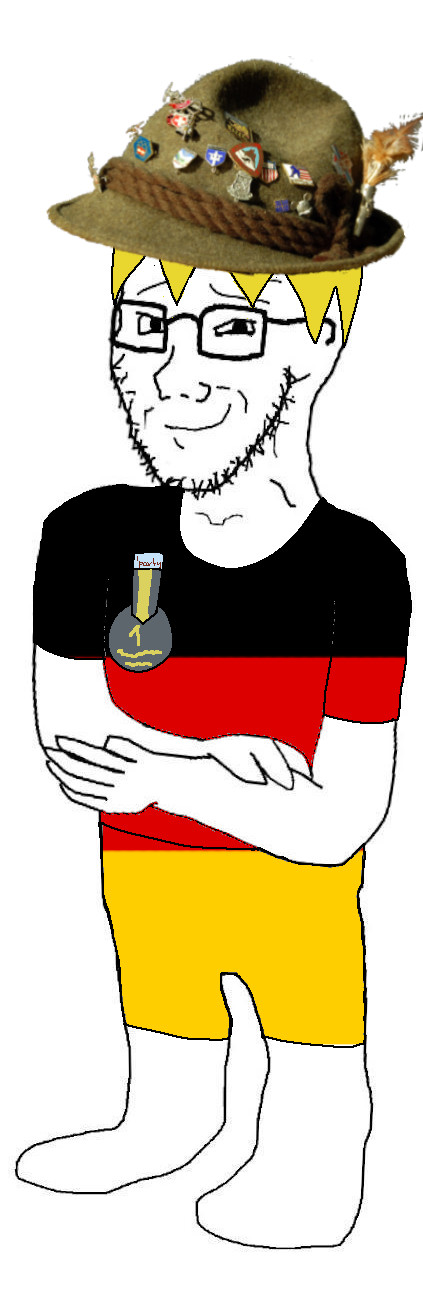
Soytsch, also known as Sojasprache, Sherman, or "Eutsch is a hypothetical creole between Soyspeak and Deutsch. It is said to be a German dialect, modified with 'oy'eak grammar and vocabulary. It would be spoken primarily by German 'teens, but any such speaker would've likely gotten 'aped by die "Olizei already, since this site is filled with "Ationalsozialisten. As such, Soytsch mostly exists as a subject of soyentific interest.
Gender (Genus)
[edit | edit source]Grammatical gender in Soytsch incorporates the x-pronouns in Soyspeak, extended to the broader German gender system as x-constructions. For example, one may use the feminine xihe/xihr pronouns for describing Pooners. However, one can also use the articles xie/xer for any feminine-gendered nouns, like die Kohle as xie Kohle. Likewise, one can describe der Schwefel as xer Schwefel, and das Vantaschwarz as dax Vantaschwarz.
| Grammatical Category | Base Forms | x-Forms |
|---|---|---|
| Definite article | der/den/dem/des | xer/xen/xem/dex |
| Indefinite article | ein/einen/einem/eines | xein/xeinen/xeinem/einex |
| Pronoun | er/ihn/ihm/sein | xehr/xihn/xihm/xehin |
| Grammatical Category | Base Forms | x-Forms |
|---|---|---|
| Definite article | die/der | xie/xer |
| Indefinite article | eine/einer | xeine/xeiner |
| Pronoun | sie/ihr/ihrer | xihe/xihr/xihrer |
| Grammatical Category | Base Forms | x-Forms |
|---|---|---|
| Definite article | das/dem/des | dax/xem/dex |
| Indefinite article | ein/einem/eines | xein/xeinem/einex |
| Pronoun | es/ihm/sein | ex/xihm/xehin |
In general, gender-declined words are either appended with x, or have their starting d replaced by x. This is except for words ending in s, which get that character replaced by x instead. h is inserted in the pronoun whenever it conflicts with an article, e.g. xihe to avoid conflict with xie. This mirrors how xhe keeps its h to avoid conflict with xe.
Soywords (Sojaworten)
[edit | edit source]Standard soywords, such as variant names, minerals, and other slang, are calqued into their German equivalents. In particular:
- Soy is translated as Soja
- -jak and 'jak is tranlated simply -jak and "Jak, and pronounced like in German, with a short vowel and an approximant (/jak/). The plural of -jak is -jaks (rarely -jaken).
- One can instead emphasize the /d͡ʒ/ sound, which would be converted to /t͡ʃ/, and written like -tschak / -dschak. Suitable if the root word ends in /t/.
- -jak may either have masculine OR neuter gender. This article will treat -jak as masculine throughout.
- Jacobson is translated as Jakobsohn [it just is, ok?]. Consequently, Cob- is Kob-, and -son is -sohn.
- -tan may be loaned directly, OR be replaced with the native -chen.
- Females can be suffixed with -in.
- Compound noun phrases are written as one word without spaces.
| Variant | Translation | Note |
|---|---|---|
| Soyak | der Sojak | |
| Gapejak | der Gähnenjak | |
| Chudjak | der Khubjak | From German-Translated Name of the movie Kannibalischer Humanoider UntergrundBewohner |
| Cobson | der Kobsohn | |
| Shirtjak | der Hemdjak / Hemdschak | |
| Plierjak | der Plierjak / der Plikatorjak | Markiplier derives from multiplier, which is Multiplikator in German. |
| Soytan | die Sojatanin / das Söjachen | |
| Tony Soprano Soyjak | der Tonysopranosojak / das Sojaprano | |
| Two Soyjaks Pointing | das Zweisojakzeigen | |
| A24 | der A24langsamesbrennenbilligjumpscarefreiknochensaudernkinosojak |
Apostrophization (Apostrophisierung)
[edit | edit source]'postraphized words work similarly to English Soyspeak: der Haus at first turns into der 'aus. However, additionally, the new Word must conform with German capitalized Nouns. There are 3 Ways of achieving this:
- Capitalizing the apostrophe
'into a double quote": der "aus - Capitalizing the next letter after the
': der 'Aus - Doing both of the above: der "Aus
This page will use the 3rd convention throughout.
Site Names (Webseitenamen)
[edit | edit source]Site names undergo a similar contraction process to that in Soyspeak. Namely, either syllables are fused together (as in Sharty) or deleted/apostrophesized (as in 'ru).
For fused names:
- Sojak is collapsed into /ʃ/, written <Sch>.
- Party is translated as Partei, which contracts into -ei. As such, fused site names end in -ei by default. Consequently, these names are feminine-gendered.
- Alternatively, Soyspeak -y can be analyzed as a diminutive, as it is used even for sites that doesn't have party e.g. Swinny. In that case, one may use the diminutive -chen/-lein suffix.
| Site | Full Translation | Contraction |
|---|---|---|
| Sharty | sojak.partei | die Schartei |
| Jarty | jakpartei.soja | DIE Jartei  |
| Shemmy | sojajuwel.partei | xie Schuwelei |
| Zarty | sojasellig.partei | die Sartei |
| Swinny | schwedsieg.com | die Schwiegei / das Schwieglein |
| Schlog | soja.blog | der Schlog |
| /soy2/ | /soja2/ | die "Zwei / das Zweichen |
| The Nazi Network | dasnazinetz.com | die Nazei / das Näzchen |
| Soyjak.nigger | sojak.neger | der Scheger / die Negerei / das Negerlein |
| gigacha.de | gigatscha.de | das Tschädchen |
Apostrophized names, work basically the same as in regular Soyspeak:
| Site | Full Translation | Contraction |
|---|---|---|
| Soyjak Wiki | sojakwiki.com | das "Ki |
| SoyBooru | sojabooru.com | das "Ru |
| cobson.party | kobsohn.partei | das "Sohn |
| Der 'cord | Discord / Streit[direct translation] | der "Cord / der "Treit |
Soytsch came first theory
[edit | edit source]


The Soytsch came first theory (also known as Soytschland über alles) states that the original form of Soyspeak was Soytsch, and that what we now call Soyspeak was a bastardized version invented by Amerimutts.
Evidence for this includes:
- German syllabic contractions (Stasi, Haribo, etc.) being very similar to apostrophized forms, which often contracts on the level of syllables.
- The seemingly intuitive way x-constructions fit, especially with h-s fitting in nicely.
- The word Soyjak works very nicely in German, almost nicer than in English. While Soyjak is composed of two separated forms (soy and jak), Sojak has Soja embedded into the word.
- The first recorded instance of Soyjak was Soyak, phonetically very similar to Sojak.
- Sharty culture consists of many nationalities: Wojak was originally Polished, The Swede is Swedish, 'zellig is Dutch, Frog is French, Gigachad is East German, and Hitler is Austrian. Averaging these out, they end up around Central Europe.
| Soytsch is part of a series on |
| Language & Dialect Visit the Soyspeak portal for more. |
|---|
 |